


Last updated 1 October 2026
AI is no longer a demo sitting on an ERP roadmap slide. In 2026 it is in the core of most mid-market ERP platforms, and it is changing how they are priced. On 17 September 2026, Mark Belkin and Stephen Archer from Stratus ran ERP Showdown: Which ERP leads the race in AI? The session compared eight ERP platforms on one question: what does the AI actually do for an Australian business today? This is the full write-up, platform by platform, with the slides, the scores, the pricing maths and the questions to ask before you sign.
The short answer
- Most complete agent toolkit: Microsoft Dynamics 365 Business Central, and Wiise, which inherits all of it. Model the credit burn first.
- Safest answer on Australian data: MYOB Acumatica, with Anthropic models running in ANZ data centres. Flexible, but you build the agents yourself.
- Most AI included for the money: Oracle NetSuite, with 1,000 AI Units per user per month, provided the feature you want has left North America.
- Deepest manufacturing agents: Epicor Kinetic, with 18+ vertical agents generally available in Australia since August 2026.
- Fastest-moving AI: Odoo, which also puts the most governance work back on you.
- Most mature finance AI: Sage Intacct, as long as finance is the whole scope.
- Strongest data sovereignty: Pronto Xi, on Australian GPUs, sitting on the least proven AI of the eight.
The eight contenders in ERP Showdown: AI.
Everything below reflects what was generally available in Australia as at September 2026, researched from vendor documentation, release notes and public announcements. ERP AI changes monthly. Treat this as a starting point and confirm availability, pricing and regional rollout in writing with each vendor before you decide.
What this guide covers
- Why AI in ERP became a buying criterion in 2026
- How we compared the eight platforms
- MYOB Acumatica, Oracle NetSuite, Microsoft Business Central, Wiise, Epicor Kinetic, Odoo, Sage Intacct, Pronto Xi
- The eight side by side
- AI maturity, scored
- What ERP AI actually costs
- The five things that actually matter
- The mistakes that cost buyers the most
- Due diligence questions for vendors and partners
- Questions from the live session
- FAQ
Why AI in ERP became a buying criterion in 2026
A couple of years ago, AI inside an ERP was something you saw at a conference. Now it ships in the product. As Stephen put it during the session, it went from a demo to something you are suddenly being asked to pay for.
Microsoft moved first. Business Central's Sales Order and Payables Agents reached general availability in November 2025, built on its OpenAI partnership. Epicor Prism reached ANZ general availability in August 2026. Pronto announced its AI suite on 8 September 2026, nine days before the webinar. The rest of the field has spent the last twelve months catching up.
The money is following. Gartner expects 62% of cloud ERP spending to go to AI-enabled solutions by 2027, up from 14% in 2024. It also expects 40% of enterprise applications to be integrated with task-specific AI agents by the end of 2026, up from less than 5% in 2025.
Three things have changed for buyers as a result:
- Roadmaps are being reshuffled. Vendors are deprioritising other work to ship AI, so the roadmap you were shown last year may not be the one you get.
- Pricing has moved to consumption. Copilot Credits, AI Units and token charges mean a per-user price no longer tells you what the software will cost.
- Failure rates are high. Gartner expects more than 40% of agentic AI projects to be scrapped by the end of 2027 on cost and unclear value.
The practical rule from the session: don't buy the demo. Ask what is generally available in Australia today, what one transaction costs, and which country your data is processed in.
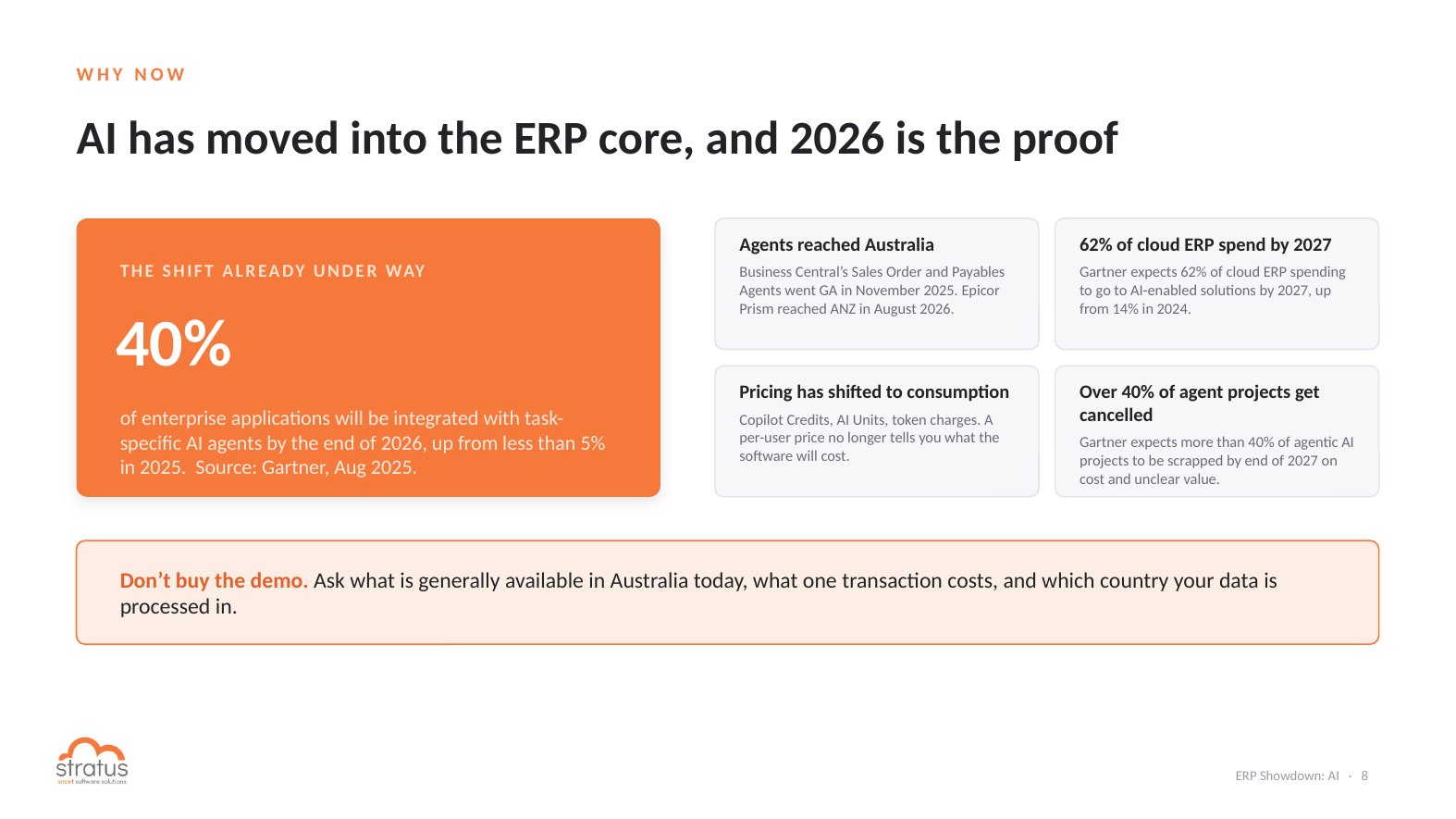
Why 2026 is the year AI became an ERP selection criterion.
How we compared the eight platforms
The session covered the eight platforms Australian mid-market businesses realistically shortlist: MYOB Acumatica, Oracle NetSuite, Microsoft Dynamics 365 Business Central, Wiise, Epicor Kinetic, Odoo, Sage Intacct and Pronto Xi. One rule applied throughout. We showed what is generally available in Australia today. Where a feature is in preview, beta or early adopter, or only live in North America or Europe, we said so.
Each platform was assessed on four things that decide whether ERP AI delivers:
- Shipping in Australia today: generally available here, not on a roadmap.
- Agent depth: whether it ships agents that take actions, or gives you the tools to build them.
- Data sovereignty: where the AI processing happens and whether your data trains anyone's model.
- Cost transparency: whether you can work out what the AI will cost at your volumes.
Stratus is an independent Australian ERP consultancy. We implement several of these platforms, which is why we have a view on where each one delivers and where it doesn't. The session was a comparison, not a pitch.
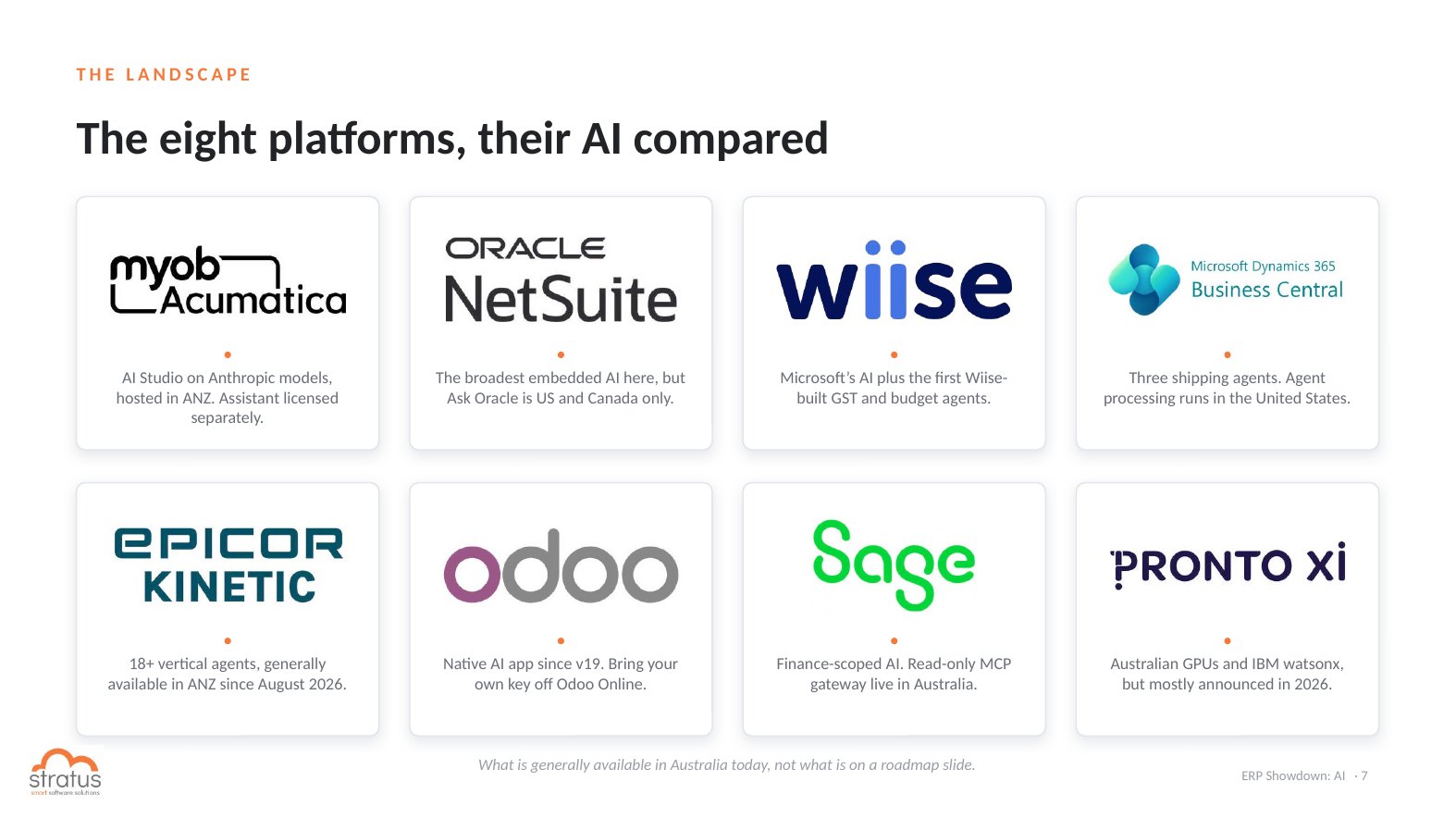
The eight platforms and a one-line read on each one's AI.
1. MYOB Acumatica: practical AI, hosted onshore

The analogy: a Toyota LandCruiser. Built to last and practical, doing unglamorous work well. You also get each new model after everyone else.
What is shipping in Australia
MYOB Acumatica's AI first arrived in 25 R2, the current ANZ release. It covers AP invoice recognition, expense receipt capture, and production and GL anomaly detection, with AI Studio in tech preview. The 26 R1 build is rolling out to ANZ tenants now. It brings full AI Studio (now renamed AI Automation), the conversational AI Assistant, and field-level data masking so real values never reach the language model.
AI Automation is a no-code environment for building prompts and agents over your own records. Generating product descriptions or pulling market information into a record are typical examples. You can choose your model: Anthropic via AWS Bedrock by default, or Azure or OpenAI, with token tracking.
Strengths
- Anthropic models delivered through AWS Bedrock, hosted in ANZ data centres
- No-code AI Studio for building prompts and agents on your own data
- Embedded machine learning already live: AP recognition, receipts, anomaly detection
- Choice of Anthropic, Bedrock, Azure or OpenAI
- A full-access MCP server built by Stratus, so tools like Claude or ChatGPT can work with your Acumatica data
- AP automation priced in tiers by document volume, separate from AI Units
Watch-outs
- ANZ runs six to nine months behind Acumatica's global releases, though MYOB is working to close the gap
- AI Studio is still tech preview on 25 R2, with general availability arriving in 26 R1
- The AI Assistant is licensed separately and metered in AI Units
- Agents are prompts you build yourself rather than packaged, supported agents
Mark added an important point on the scoring. Acumatica's agent depth scored lower only because it doesn't ship standard agents out of the box yet. The agent-building capability is strong. You just have to tell it, in natural language, what you want it to do.
| Models | Anthropic via AWS Bedrock (Azure and OpenAI also supported) |
|---|---|
| AI cost | No published AI price. Assistant licensed, AI Units metered with a base inclusion |
| Data | ANZ data centres, not used to train external models |
The Stratus take: the safest answer on Australian data. Flexible and powerful with the Stratus extensions, but you need to bring the ideas.
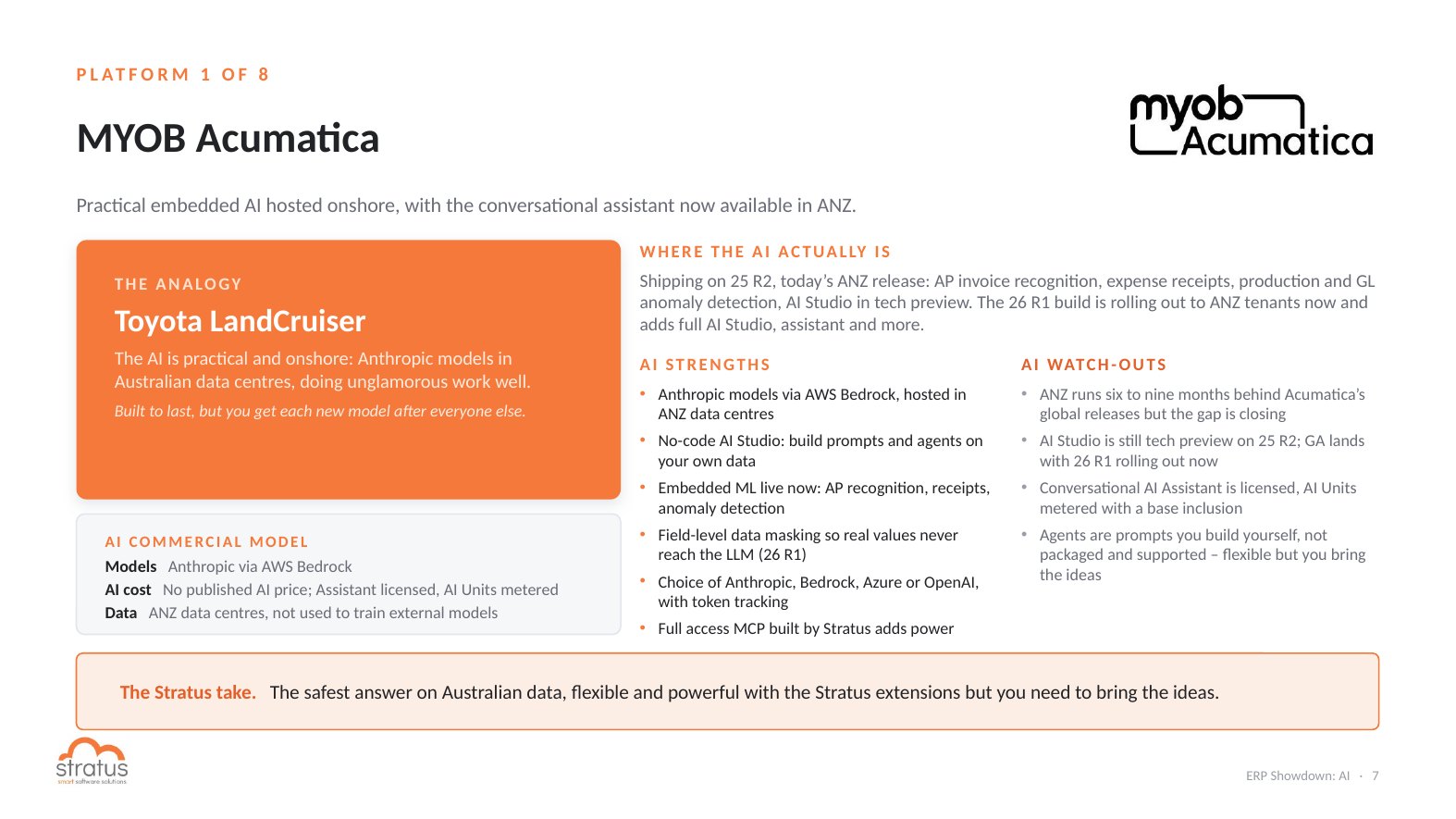
MYOB Acumatica: strengths, watch-outs and commercial model.
2. Oracle NetSuite: the broadest embedded AI

The analogy: a private jet. A lot of the AI comes with the ticket. The newest cabin only flies North American routes, and the best seats still cost extra.
What is shipping in Australia
Text Enhance, Narrative Insights, AI bank matching and Intelligent Close are live in Australia. Narrative Insights is documented as available in every NetSuite region and covers financial, inventory, sales, payroll, AR and AP reports. The headline releases, NetSuite Next and Ask Oracle, remain US and Canada only.
NetSuite is also one of the few vendors that publishes what AI actions consume. An Ask Oracle question is about 10 AI Units for a simple query and 50 to 100 for a research-style request, and a Narrative Insights report runs 5 to 200 units.
Strengths
- 1,000 AI Units per user per month included with eligible licences, pooled across the organisation
- Broad embedded AI already live in Australia across finance
- An open MCP connector, so you can use Claude or ChatGPT on governed NetSuite data
- Nucleus Research reports 25% to 33% finance productivity gains
Watch-outs
- NetSuite Next and Ask Oracle are US and Canada only
- The richer AI sits in paid add-ons such as EPM, Bill Capture and Analytics Warehouse
- AI Units expire each term, and heavy use means buying top-up packs
- Your NetSuite tenant is hosted in Sydney and Melbourne, but Oracle's generative AI regions in APAC are Osaka and Hyderabad
| Models | Cohere Command, OpenAI GPT-OSS and GPT 4.x/5.x |
|---|---|
| AI cost | 1,000 AI Units per user per month included, then top-up packs |
| Data | Not used for third-party training. Generative AI may be processed outside Australia |
The Stratus take: the most AI included for the money, provided the features you want have left North America.
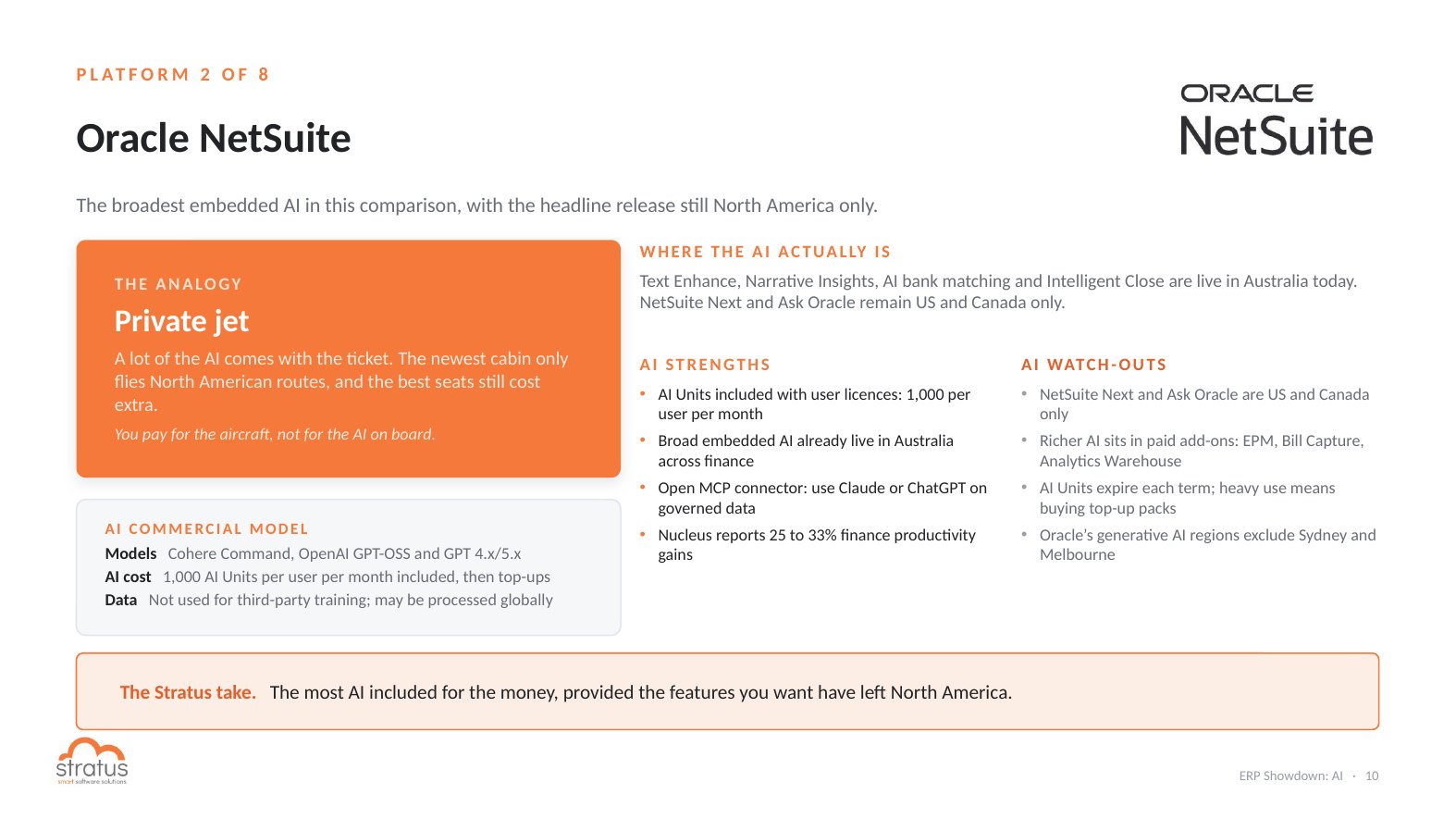
Oracle NetSuite: strengths, watch-outs and commercial model.
3. Microsoft Dynamics 365 Business Central: the most complete agent toolkit

The analogy: LEGO Technic. Every piece you need to build agents, and a bill that grows with how many bricks you use. The build is only as good as whoever configures and governs it.
What is shipping in Australia
Copilot chat, summaries, data analysis and bank reconciliation are included in the licence. Three first-party agents ship: the Sales Order Agent, the Payables Agent and the Expense Agent, which was still in preview in September 2026. Agent Designer lets you build custom agents in natural language, with general availability scheduled for October 2026. Every Copilot and agent feature is listed as available for Australia.
The bigger story is the platform around it. Business Central sits on Dataverse and the Power Platform, so Copilot Studio can build agents that work across your ERP data and everything else in the Microsoft stack. Stephen called Copilot Studio a game changer. The MCP server is generally available too, so you can build agents from Copilot Studio or VS Code.
Governance is well thought through. You can name reviewers for agents and decide which next actions need a human sign-off.
Strengths
- Copilot chat, summaries, analysis and bank rec included in the licence
- Three first-party agents shipping, each with human review steps
- MCP server generally available
- Agent Designer for building custom agents in natural language
- Copilot Studio across the wider Dynamics and Power Platform estate
Watch-outs
- Agents bill in Copilot Credits: 50 per invoice plus 5 per line
- For Australian tenants, agent processing happens in the United States
- Australia was excluded from the initial GPT-5.3 agent model rollout
- The Expense Agent and Agent Designer were still preview in September 2026
| Models | Azure OpenAI, with GPT-5.3-chat the default for agents |
|---|---|
| AI cost | Copilot included. Agents metered at US$200 per 25,000 credits |
| Data | Copilot processed in-geo, agents in the US. No training without consent |
The Stratus take: the most complete agent toolkit here, but model the credit burn before you sign anything.
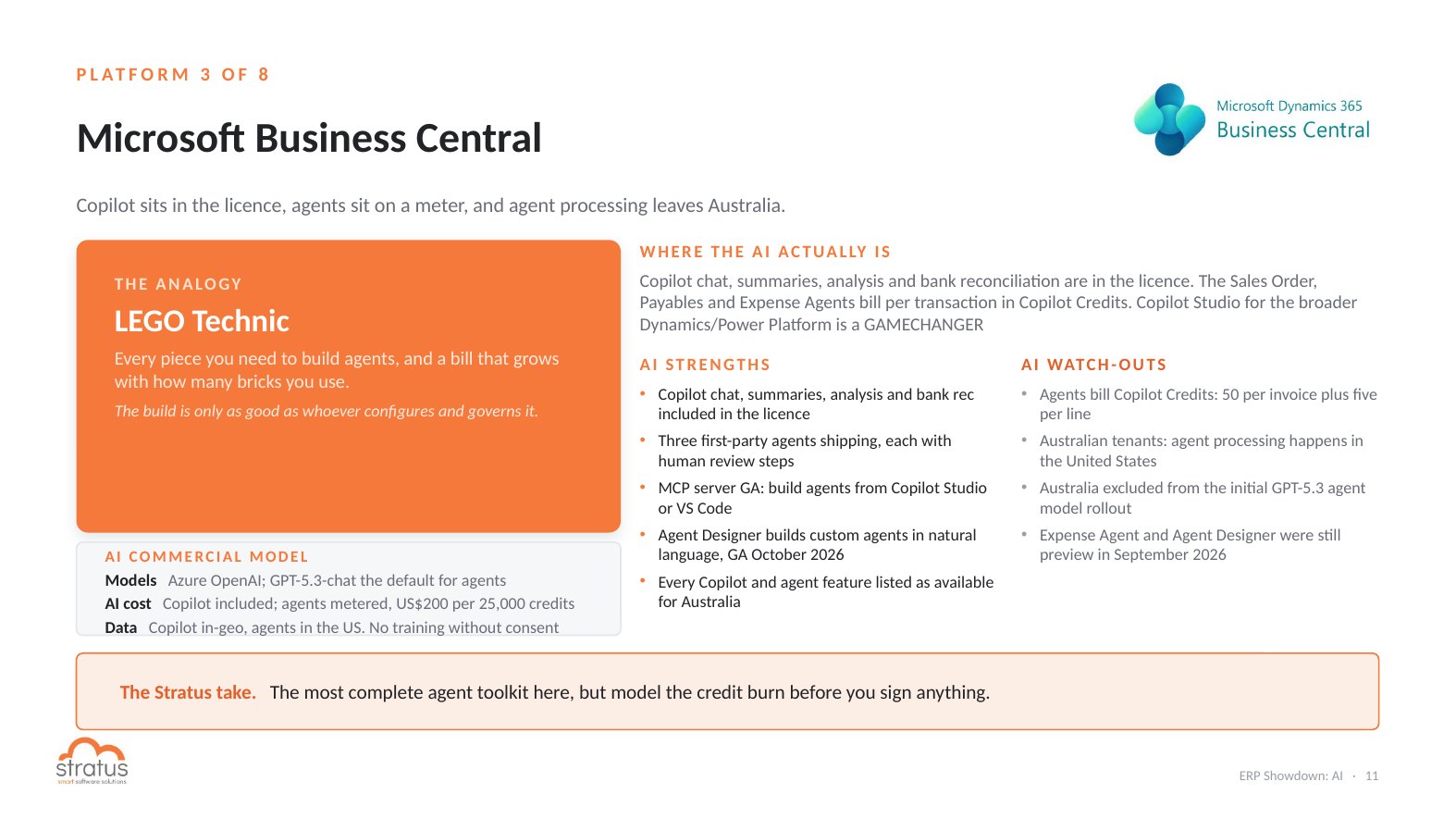
Microsoft Business Central: strengths, watch-outs and commercial model.
4. Wiise: Microsoft's AI with an Australian accent

The analogy: a Ford Ranger. The engine is Microsoft's. Wiise adds the Australian dashboard and has started building its own instruments.
What is shipping in Australia
Wiise is Business Central with Australian localisation built in, so it inherits every Business Central Copilot feature and agent. The Sales Order and Payables Agents have been live for Wiise customers since October 2025. Copilot bank reconciliation pairs with Wiise's Australian bank feeds.
Wiise is now building its own AI on top:
- GST Agent: validates every posted transaction against GST rules. In limited beta.
- AI Budget Forecasting: builds projected budgets from your general ledger history by account and dimension.
- GTM IQ: an analysis layer over your ERP data that compares your ideal customer profile with your actual customers and helps find similar businesses to target. Stephen compared it to tools like ZoomInfo, except it starts from what is in your own ERP.
Watch-outs
- Almost all of the AI is Microsoft's. Wiise-native AI is beta or early access
- Agents cost extra, at about A$299 a month per 25,000 credits
- Agent processing runs in the US, the same as Business Central
- An announced NDIS AI auditor has not shipped yet
| Models | Microsoft Azure OpenAI, inherited from Business Central |
|---|---|
| AI cost | Copilot included. Credits sold only as prepaid packs |
| Data | Australian Azure hosting. Agent processing in the US |
The Stratus take: Business Central's AI with local compliance around it, from a vendor now shipping its own agents.
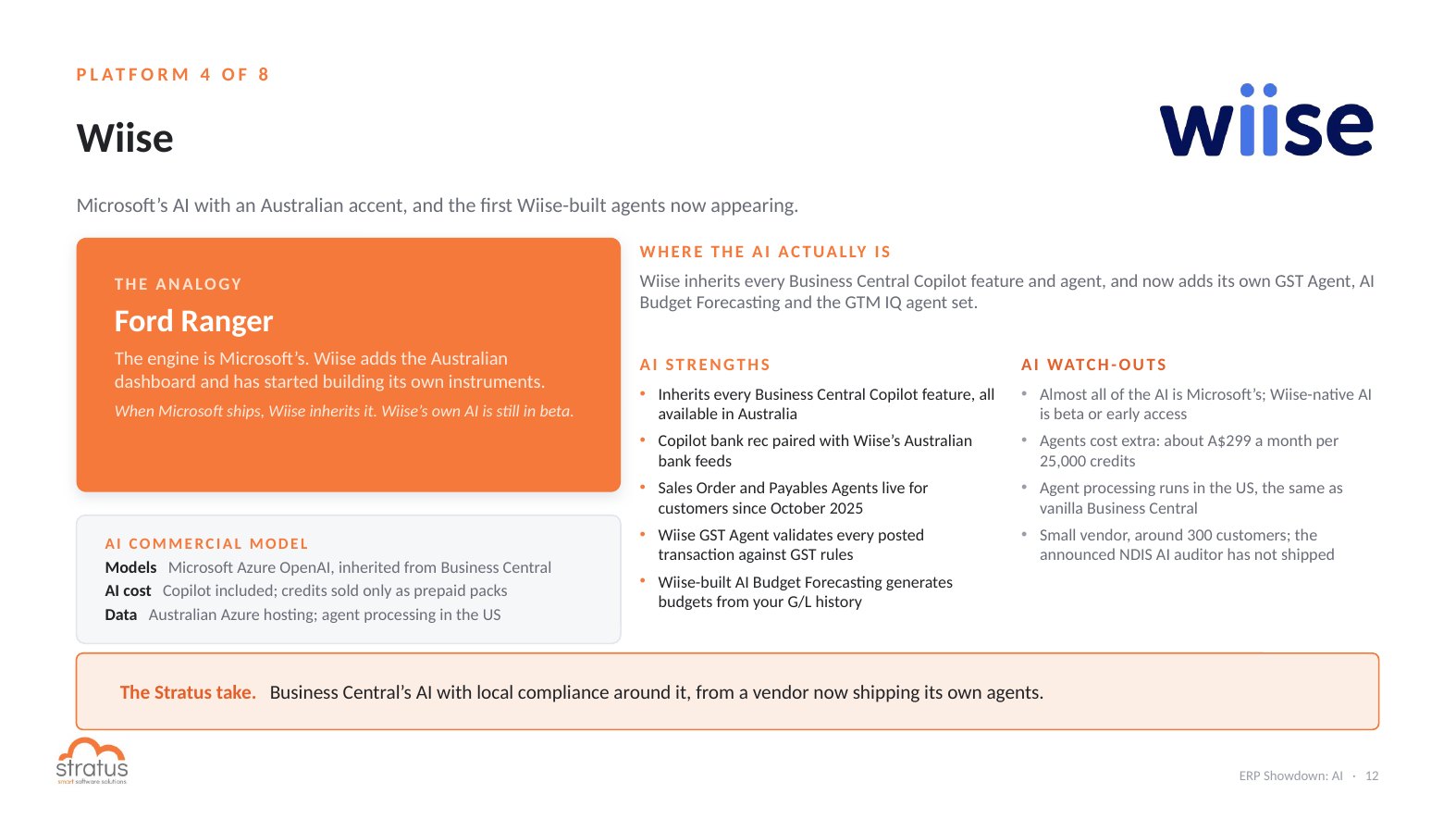
Wiise: strengths, watch-outs and commercial model.
Free guide: compare all eight platforms on fit, pricing and implementation, not just AI. Download the ERP Selection Guide
5. Epicor Kinetic: the deepest library of vertical agents

The analogy: a factory line. An ERP production line dialled in over decades. Its agents know what a work order is, not just what a document is.
What is shipping in Australia
Epicor Prism reached ANZ general availability on 2 August 2026 for Kinetic and Prophet 21 cloud customers. It ships 18+ pre-built agents, the Reasoning Agent and Prism Developer. That is the deepest library of vertical agents in this comparison by a fair distance. The other platforms are generalists. Epicor built its agents for manufacturing.
Prism Developer writes Kinetic customisations from natural language, and Epicor claims it cuts build and test time by roughly 60%. Agent Foundry and MCP let you build your own agents or bring your own LLM.
Epicor also has something nobody else in the comparison has tried: outcomes-based AI pricing. Its RFQ agent bills only on the requests for quote that convert to purchase orders. For now, that agent is US and Canada only.
Strengths
- 18+ pre-built vertical agents, generally available in Australia since August 2026
- Every agent action needs human approval, and Prism inherits the logged-in user's ERP role security
- Customer data isolated per tenant, not used to train base models
- An outcomes-based pricing precedent
Watch-outs
- Cloud only. There is no Prism on-premise, and the final on-premise feature releases for Kinetic and Prophet 21 are scheduled for 2028
- No public pricing. Customers report tiered user fees plus per-request charges
- Confirm in writing which agents your ANZ tenant actually gets
- Analysts describe customer adoption as early-stage and exploratory
| Models | Not disclosed. Open architecture, bring your own via MCP |
|---|---|
| AI cost | Licensed add-on, no public price |
| Data | Isolated per tenant, not used to train base LLMs |
The Stratus take: if your AI question is a manufacturing question, Epicor belongs on your list.
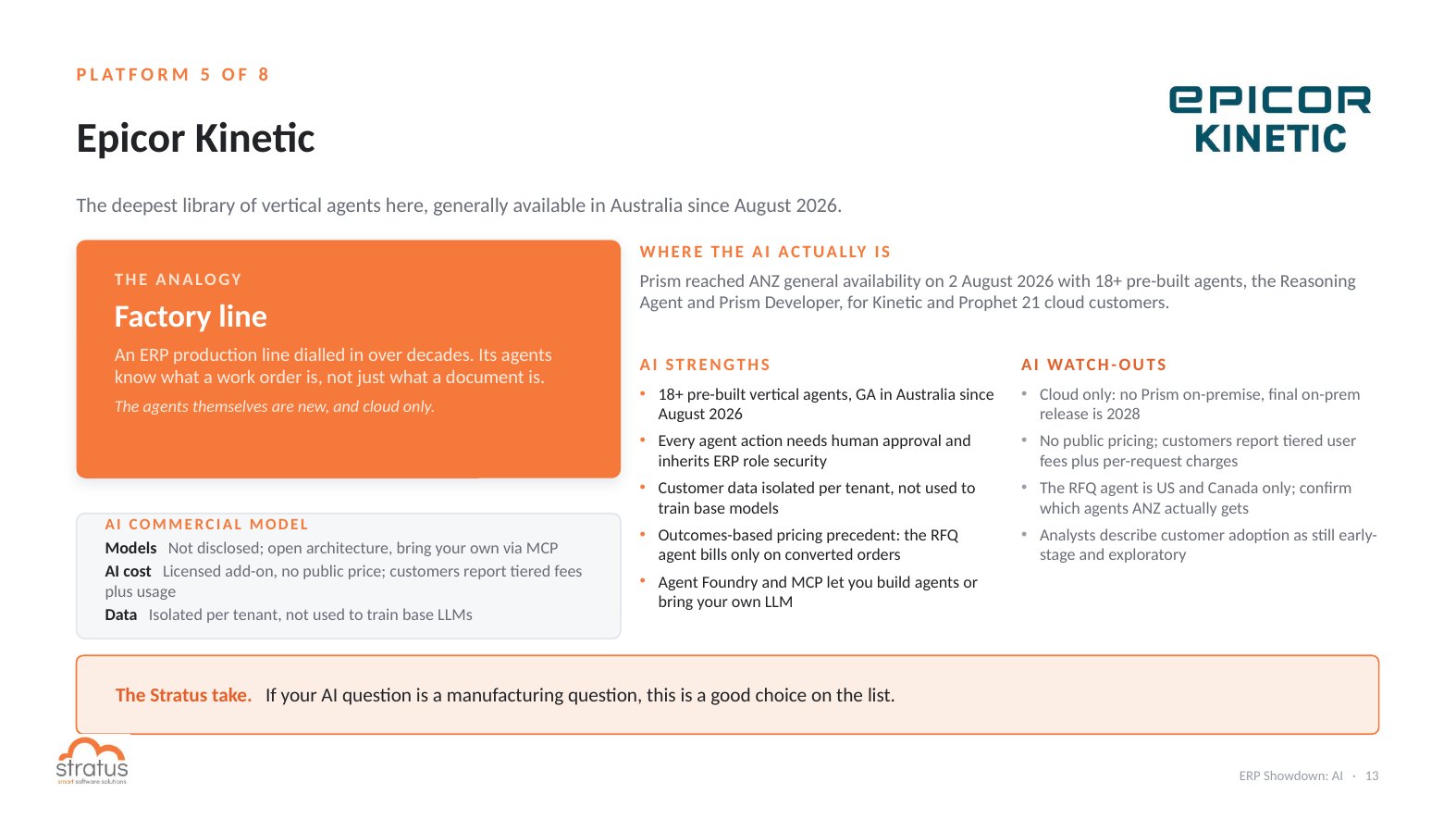
Epicor Kinetic: strengths, watch-outs and commercial model.
6. Odoo: the fastest-moving AI, with the thinnest governance

The analogy: IKEA. Most of the AI parts are in the box, at the lowest price here. You still supply the model, the key and the guardrails.
What is shipping
Odoo has moved faster than anyone. Version 19 added a native AI app in September 2025, with custom agents that learn from your documents, AI fields, Ask AI natural-language search, email drafting and AI server actions. In 2026 its agents gained the ability to create and update records, including from an uploaded PDF of instructions, and to accept voice input. MCP support followed, and an official MCP server is documented for Odoo 20, which was released at Odoo Experience on 24 September 2026, a week after the webinar.
You build agents from skills (instructions plus tools) and sources (PDFs, web links, documents and Knowledge articles). You choose OpenAI or Google Gemini, so there is no lock-in to one vendor's model. To Odoo's credit, its MCP tools require approval before they write.
Watch-outs
- Odoo doesn't publish an AI training statement or an LLM subprocessor statement, and there is no AI clause in the enterprise subscription agreement. Get the terms in writing
- Odoo Online has an Oceania region with Australian production hosting, but backups replicate to Europe and Canada, and LLM calls leave the region
- On Odoo.sh or on-premise, you bring and pay for your own LLM key
- No native rate limits and limited agent audit depth
Odoo behaves a lot like an open-source ERP, and its AI follows the same philosophy. That suits businesses that want control and flexibility. It suits businesses that want a governed, controlled environment much less. Implementation partner quality matters more here than anywhere else on the list.
| Models | OpenAI or Google Gemini, your choice |
|---|---|
| AI cost | No AI price published for Online. Your own token bill elsewhere |
| Data | Australian hosting region, but LLM calls leave it |
The Stratus take: the fastest-moving AI on this list, and the one that puts the most governance work back on you.
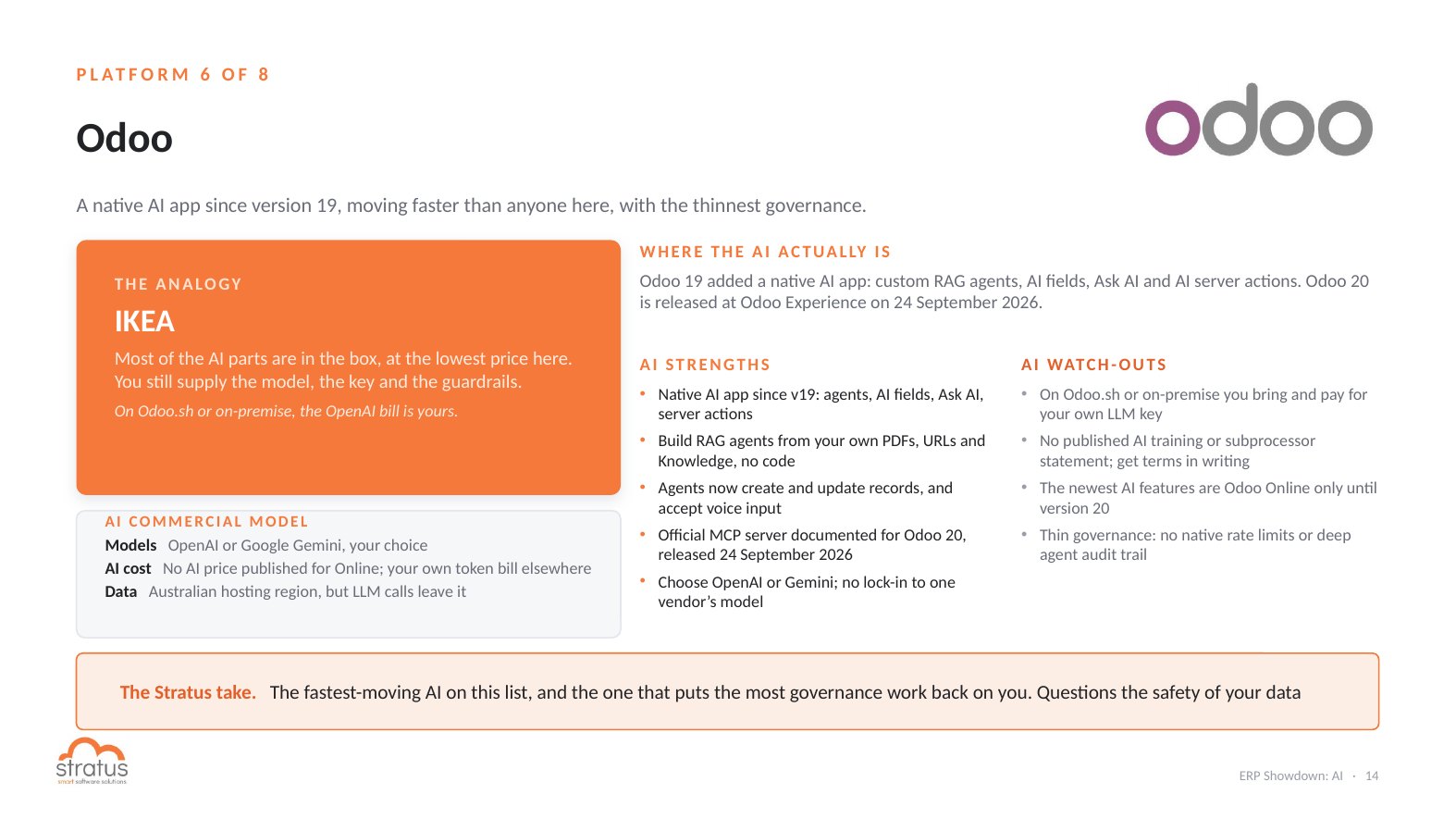
Odoo: strengths, watch-outs and commercial model.
7. Sage Intacct: the most mature finance AI

The analogy: a CFO control tower. A clear view over the close, AP and the ledger. It reports what it sees. It doesn't fly the aircraft.
What is shipping in Australia
Sage has run machine learning inside its ledgers for more than nine years. GL Outlier Detection trains on your own historical transaction patterns and flags unusual entries inside the approval cycle. AP Automation predicts general ledger and dimension coding and learns from your corrections. AP Automation, three-way matching, AP anomaly detection, GL Outlier Detection and Close Automation, with AI variance explanations, are all generally available in Australia.
The Sage AI Gateway, a read-only MCP server, became generally available in May 2026 and is live in Australia. You can point Claude or ChatGPT at your Intacct instance to query it, within the user's roles and security. It can't post transactions.
Watch-outs
- The Finance Intelligence Agent is still early adopter, US English only, admin-enabled, and answers questions without taking actions
- The AI is finance-scoped. The agent marketplace (Canada, UK and US only) and the AI Trust Label are not yet in Australia
- AP Automation and Close Automation are separately enabled subscriptions
- Sage's terms say it may analyse your data together with other Sage customers' data to develop and train its AI models. That pooled data is why its AP models are so good, but it is a different position from Microsoft and Epicor
| Models | In-house plus third-party on AWS Bedrock. LLM vendor not named |
|---|---|
| AI cost | Quote-based. AP and Close Automation sold separately |
| Data | Pooled data develops Sage models. Australian processing region not disclosed |
The Stratus take: the most mature finance AI here, as long as finance is the whole scope of the question.
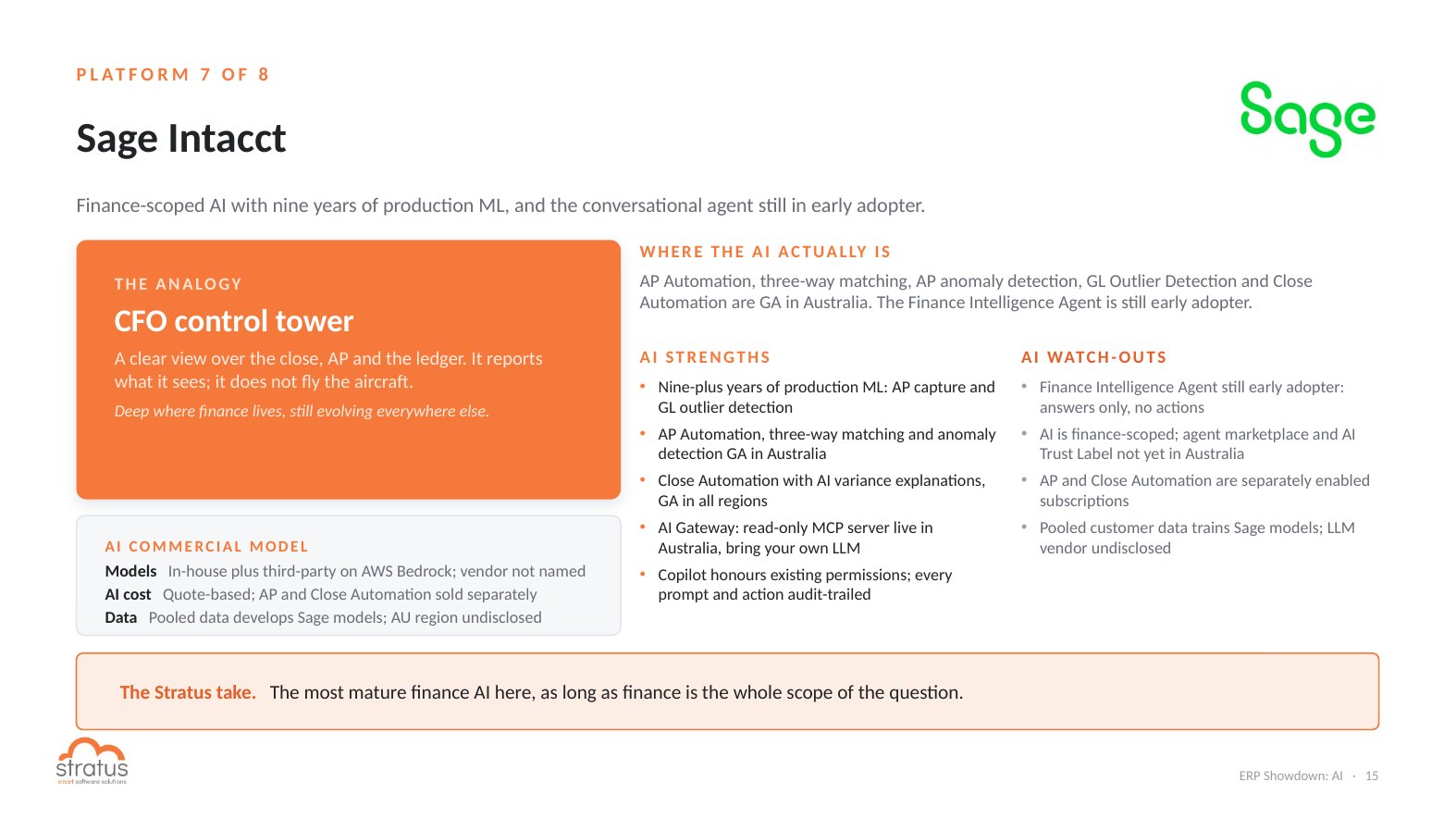
Sage Intacct: strengths, watch-outs and commercial model.
8. Pronto Xi: the only sovereign AI story

The analogy: a road train. Australian through and through. The data, the hosting and the GPUs all stay on home soil. The AI carriage was only coupled on in September 2026.
What is shipping
Pronto's 8 September 2026 release lists natural-language queries, predictive inventory demand and fulfilment forecasting, voice-enabled business intelligence, machine learning predictions for service and maintenance, agentic purchase order approvals, stock recommendations and B2B ecommerce agents. All of it runs on GPUs inside Pronto Cloud, with IBM watsonx.ai as the model platform.
Pronto bought its own GPUs rather than sending data to an external LLM service. Given how embedded Pronto is in Australian mining and asset-intensive industries, that sovereignty position is no surprise.
Strengths
- Sovereign AI: GPUs inside Australian-hosted Pronto Cloud
- Customer data never used to train shared or public models
- IBM watsonx.ai partnership and a 2026 IBM Innovative Build award
- Australian-owned and employee-owned, with 1,500+ customers and 50 years in the market
Watch-outs
- Most capabilities were announced in September 2026 and are not yet proven in the field
- MCP support is still written in the future tense on Pronto's own site
- The documented forecasting is statistical (Winter's method), not machine learning
- No public AI pricing, no AI product documentation and no IRAP assessment
| Models | IBM watsonx.ai, GPU compute inside Pronto Cloud |
|---|---|
| AI cost | Not published. Ask for it in writing |
| Data | Ring-fenced in Australia, never trains public models |
The Stratus take: the strongest data-sovereignty answer in the room, sitting on the least proven AI.
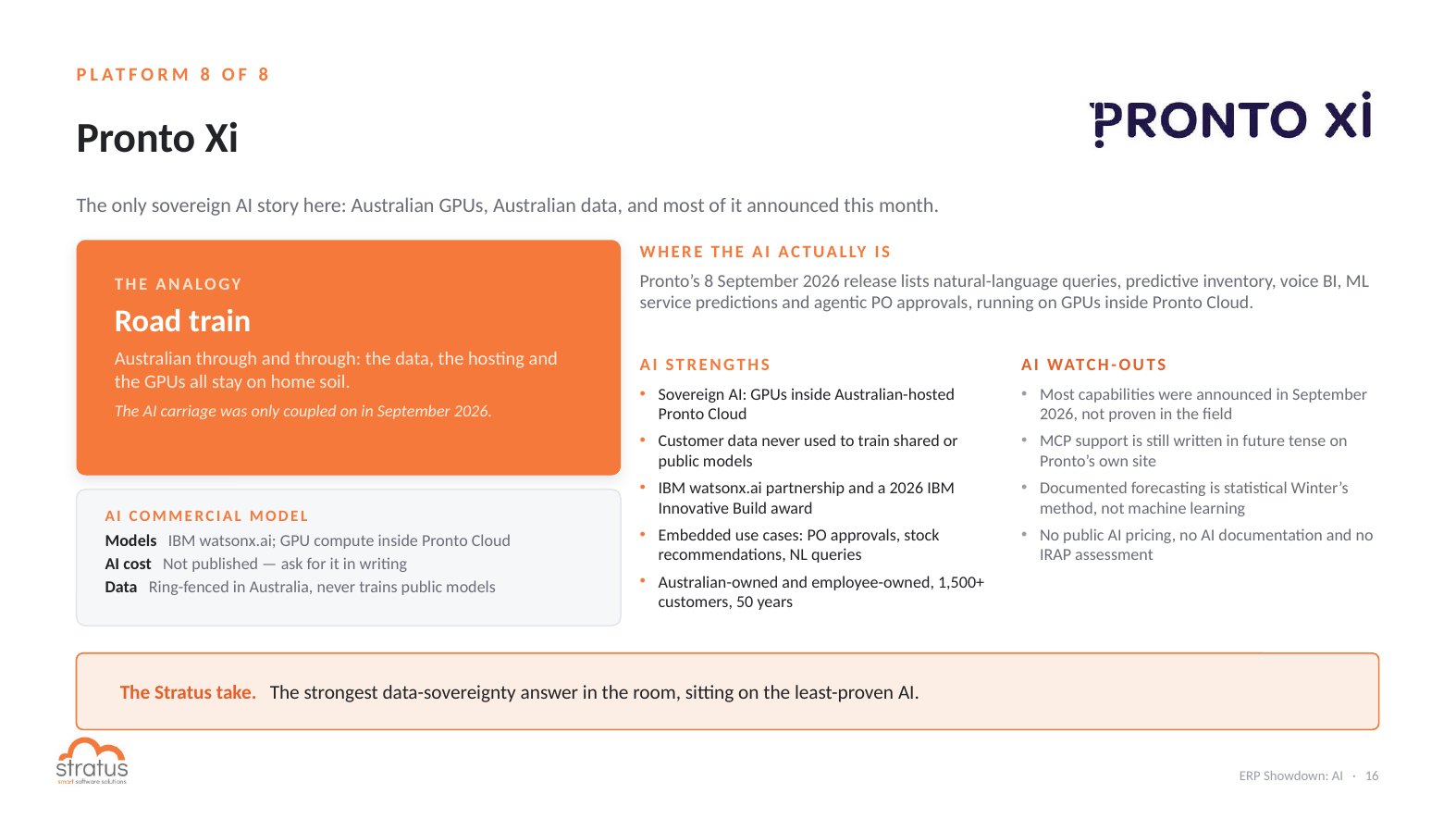
Pronto Xi: strengths, watch-outs and commercial model.
The eight ERPs side by side on AI
Every vendor has done more AI work in the last twelve months than ever before. Microsoft was ahead early, and Sage's machine learning has been running for years. Pronto is the newest. Most platforms now support agentic workflows, but not all let you build your own agents, so check whether the shipped agents are good enough for you.
| Platform | Embedded AI today | Agents you can run | How AI is charged | Data in Australia? |
|---|---|---|---|---|
| MYOB Acumatica | OCR, anomaly detection, AI Assistant | AI Studio agents you build | AI Units, 1,500 a month for the Assistant | Yes, ANZ data centres |
| Oracle NetSuite | Broadest embedded set | EPM Planning, Reconciliation | 1,000 AI Units per user per month | Generative AI processed offshore |
| Wiise | Inherits Business Central Copilot | Sales Order, Payables, GST (beta) | Prepaid Copilot Credit packs | Copilot yes, agents no |
| Business Central | Copilot in the licence | Sales Order, Payables, Expense (preview) | Copilot Credits per transaction | Copilot yes, agents no |
| Epicor Kinetic | Prism agents and Grow AI | 18+ vertical agents | Licensed add-on, no public price | Not stated by Epicor |
| Odoo | Native AI app since v19 | Custom RAG agents you build | Included on Online | Hosting yes, LLM no |
| Sage Intacct | AP, close and ledger ML | Close, AP and Assurance | Separate subscriptions | Not disclosed by Sage |
| Pronto Xi | Announced Sept 2026, unproven | Agentic PO approvals | Not published | Yes, Pronto Cloud GPUs |
On data, most platforms host your ERP in Australia. The catch is the AI processing. Business Central and Wiise agents go offshore. Oracle's generative AI goes offshore. Odoo's LLM calls go offshore even when hosting is local. Sage hasn't said. Pronto stays onshore.
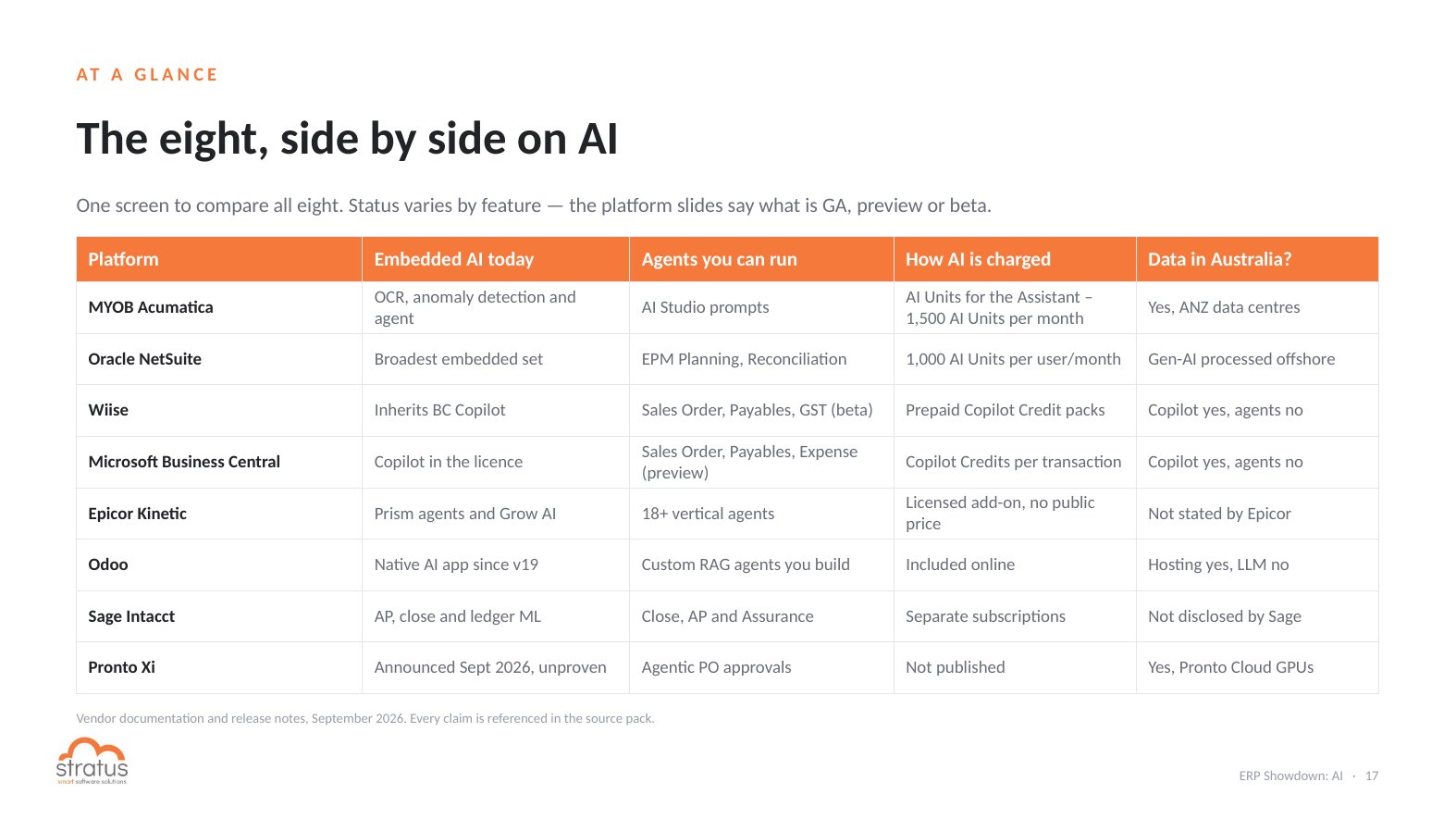
The eight, side by side on AI.
AI maturity, scored
Our read on the four things that decide whether ERP AI actually delivers, based on what an Australian customer can use today. Ratings run Leading, Strong, Capable, Limited.
| Platform | Shipping in Australia | Agent depth | Data sovereignty | Cost transparency |
|---|---|---|---|---|
| MYOB Acumatica | Leading | Capable | Leading | Limited |
| Oracle NetSuite | Strong | Capable | Limited | Strong |
| Wiise | Leading | Leading | Capable | Leading |
| Business Central | Leading | Leading | Capable | Leading |
| Epicor Kinetic | Capable | Leading | Capable | Limited |
| Odoo | Capable | Strong | Limited | Capable |
| Sage Intacct | Strong | Capable | Undisclosed | Limited |
| Pronto Xi | Limited | Limited | Leading | Limited |
Microsoft has done the most work here, largely because Copilot Studio lets agents reach beyond the ERP into Dataverse, Power Apps and the rest of Dynamics. Acumatica and NetSuite come next. Neither has Microsoft's AI relationships or a Copilot product of its own, yet both have shipped AI automation, agent building and natural-language queries in a short time. One note on the Sage row: undisclosed is not the same as compliant.
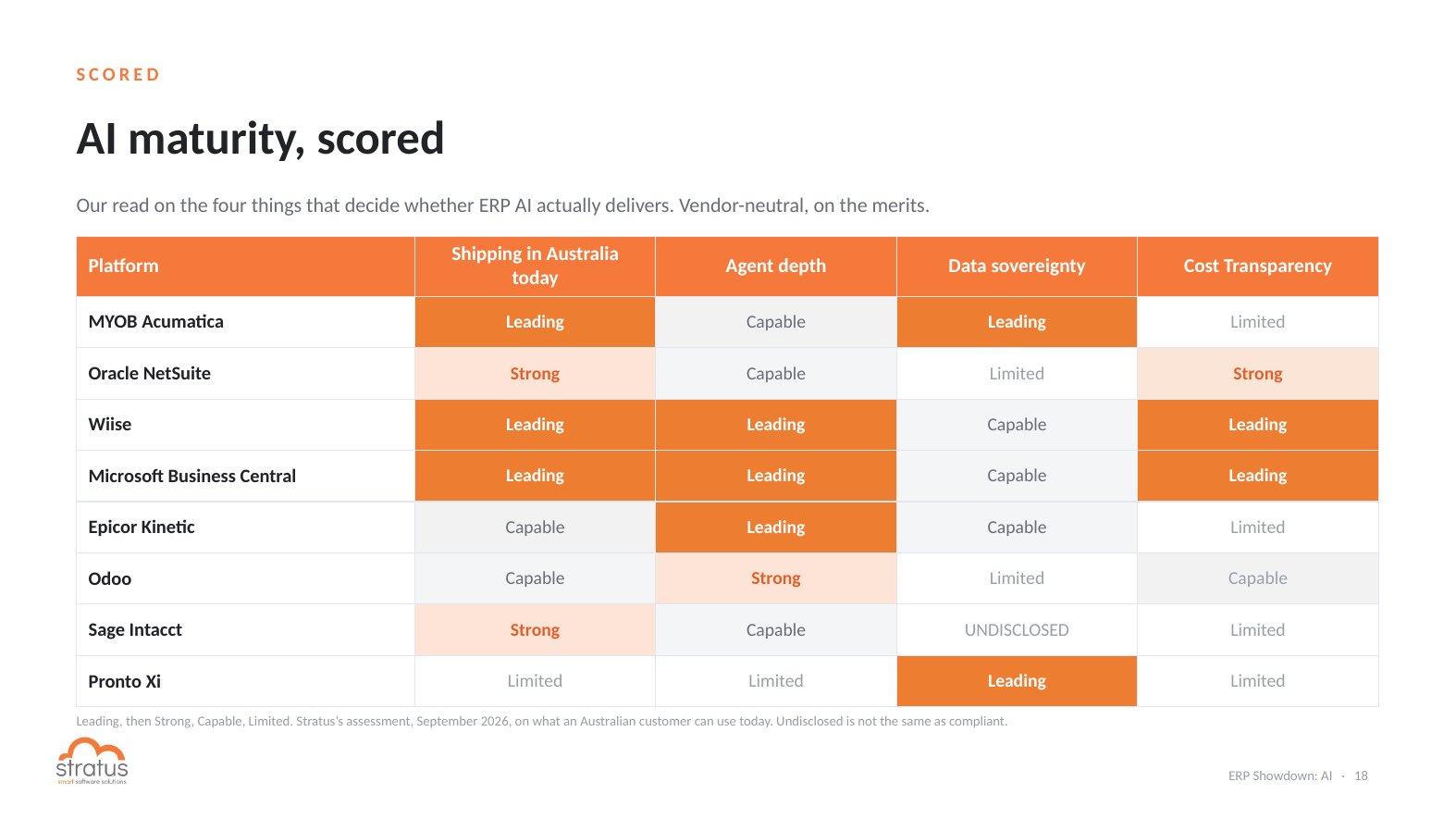
AI maturity, scored by Stratus, September 2026.
What ERP AI actually costs
If a vendor says the AI is included, ask what happens at volume. Most ERP AI is now a mix of what is included in the licence and what is metered. Standard features like anomaly detection usually ship in the licence. Agents and natural-language queries increasingly consume credits, and the cost depends on the task.
| Platform | How the AI is charged | What that means in practice |
|---|---|---|
| MYOB Acumatica | No published AI price. Assistant metered in AI Units | About 50 AI Units per question |
| Oracle NetSuite | AI Units included with licences, then top-ups | 1,000 units per user per month. Narrative Insights 5 to 200 a report |
| Wiise | Prepaid Copilot Credit packs only | A$299 a month per 25,000 credits, about 380 three-line invoices |
| Business Central | Copilot Credits, prepaid or pay-as-you-go | 50 credits an invoice plus 5 a line. US$200 (about A$300) per 25,000 |
| Epicor Kinetic | Licensed add-on, no public price | Customers report tiered user fees plus per-request charges |
| Odoo | No AI price published for Online. Own key elsewhere | Document OCR still costs one in-app purchase credit each |
| Sage Intacct | AP and Close Automation sold separately | Quote-based |
| Pronto Xi | Not published | Ask for the commercial model in writing |
A worked example
Microsoft's own example is a three-line invoice: 50 credits for the invoice plus 5 per line, so 65 credits. A 25,000-credit pack at US$200 (or A$299 through Wiise) covers roughly 380 of those invoices a month. If your Payables Agent reads 1,500 supplier invoices a month, you need about four packs. That is a cost that grows with every invoice, not with every user.
On the MYOB Acumatica side, at around 50 AI Units per natural-language question, a 1,500-unit monthly inclusion covers about 30 questions. Acumatica keeps AP document processing out of AI Units altogether and prices it in tiers by document volume, which Stephen singled out as a sensible way to keep high-volume automation predictable.
The line to remember from the session: consumption pricing means the bill grows with adoption, not with the number of users. A full report costs more than a quick question. The more your team uses the AI, and the more things they use it for, the larger the invoice. Model twelve months at your real volumes before you sign.
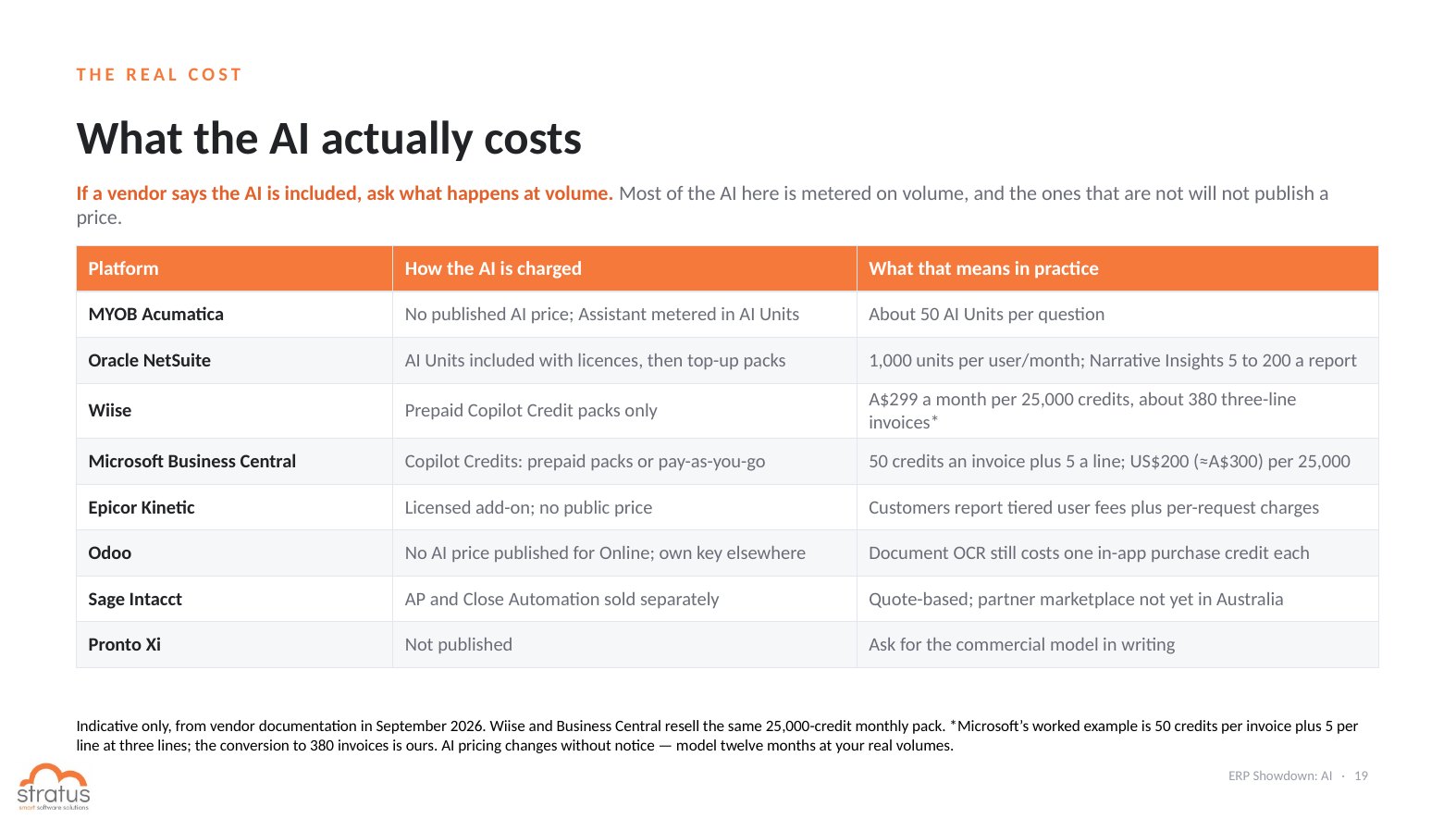
What the AI actually costs. Indicative only, September 2026.
The five things that actually matter with ERP AI
Most buyers judge AI on the demo. These five questions are where the value is won or lost.
- Shipping, or roadmap? Is the feature generally available in Australia today, or preview, beta or early adopter? The Sage Finance Intelligence Agent is a good example of something that exists overseas but hasn't reached Australia.
- Cost per transaction. AI infrastructure costs are rising. Some large US companies have found that AI transactions now cost more than the people they replaced. Know what one transaction costs.
- Where data is processed. Which country does the model run in, and does your data ever train anyone else's model? If your clients are government or defence, this may decide the shortlist on its own.
- Who stays in control. Does a human approve each action, and is every action logged? Epicor requires human approval for every agent action. Sage's MCP is read-only. Odoo's MCP tools need approval to write. Business Central lets you name agent reviewers. Ask for the approval model and the audit trail.
- Whether your data is ready. AI on messy data produces confident nonsense. If you are adding AI to an existing ERP, clean your data first. If you are moving from Xero, QuickBooks or MYOB to an ERP, make your data migration plan very tight.
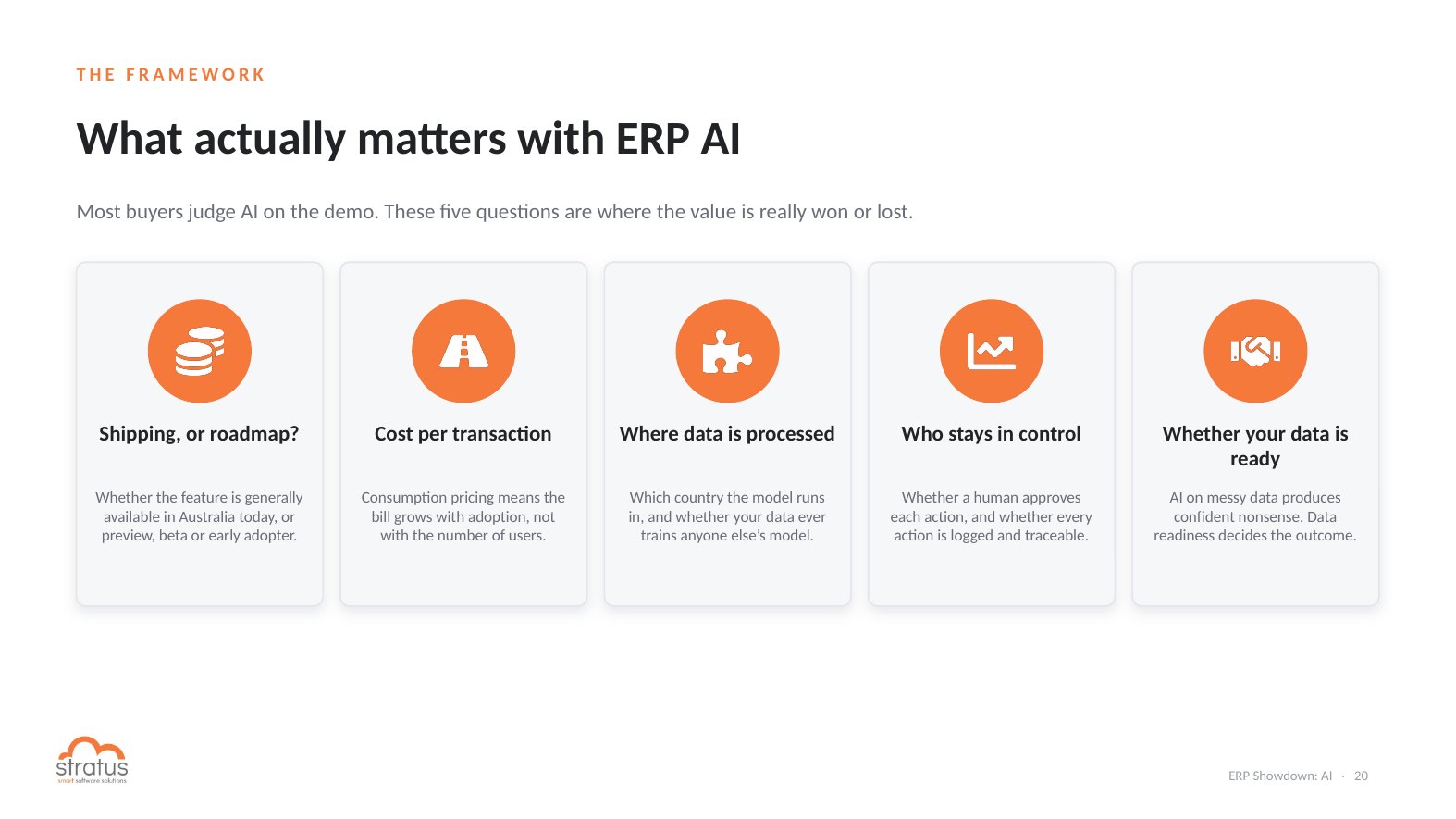
The five questions where ERP AI value is won or lost.
The AI mistakes that cost buyers the most
Buying the roadmap
ERP is a long-term investment, so the roadmap matters. But much of what gets demonstrated is preview, early adopter or not yet released in Australia. Be confident about what has been delivered, and check the roadmap applies to Australia.
Ignoring consumption pricing
Credits and AI Units mean the more your team adopts the AI, the larger the invoice. Understand the fixed pricing, the overage, and which items are metered.
Skipping the data question
Ask which country the model runs in, who processes your data, and whether it trains anyone's model.
Mistaking a chatbot for an agent
Gartner calls it agent washing: assistants, chatbots and robotic process automation rebranded as agentic AI. The test is simple. Can it take an action, and does something happen in the ERP when it does? If it only gives you text back, it is an assistant.
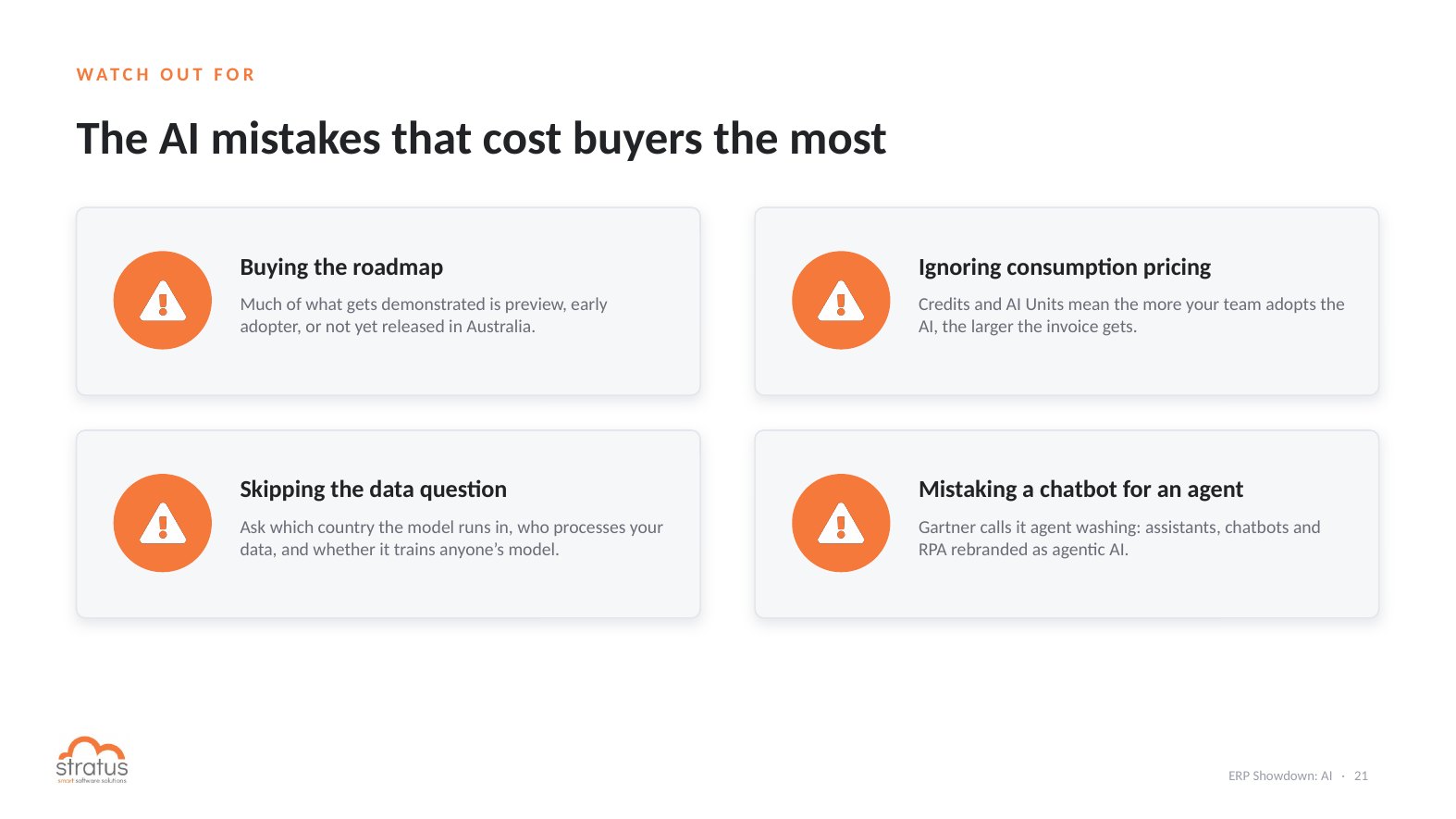
Four mistakes to avoid.
Most AI projects fail long before the software does
The technology is rarely the cause. Gartner expects more than 40% of agentic AI projects to be cancelled by the end of 2027 on escalating costs, unclear value or inadequate risk controls. It also expects 60% of AI projects unsupported by AI-ready data to be abandoned through 2026, and inference cost per agentic workflow to rise more than fivefold through 2028. MIT found 95% of organisations investing in generative AI were getting no measurable return.
Three things decide the outcome: data readiness, cost control and change management. Your people need to understand the plan and the benefits, which means you need a plan in the first place.
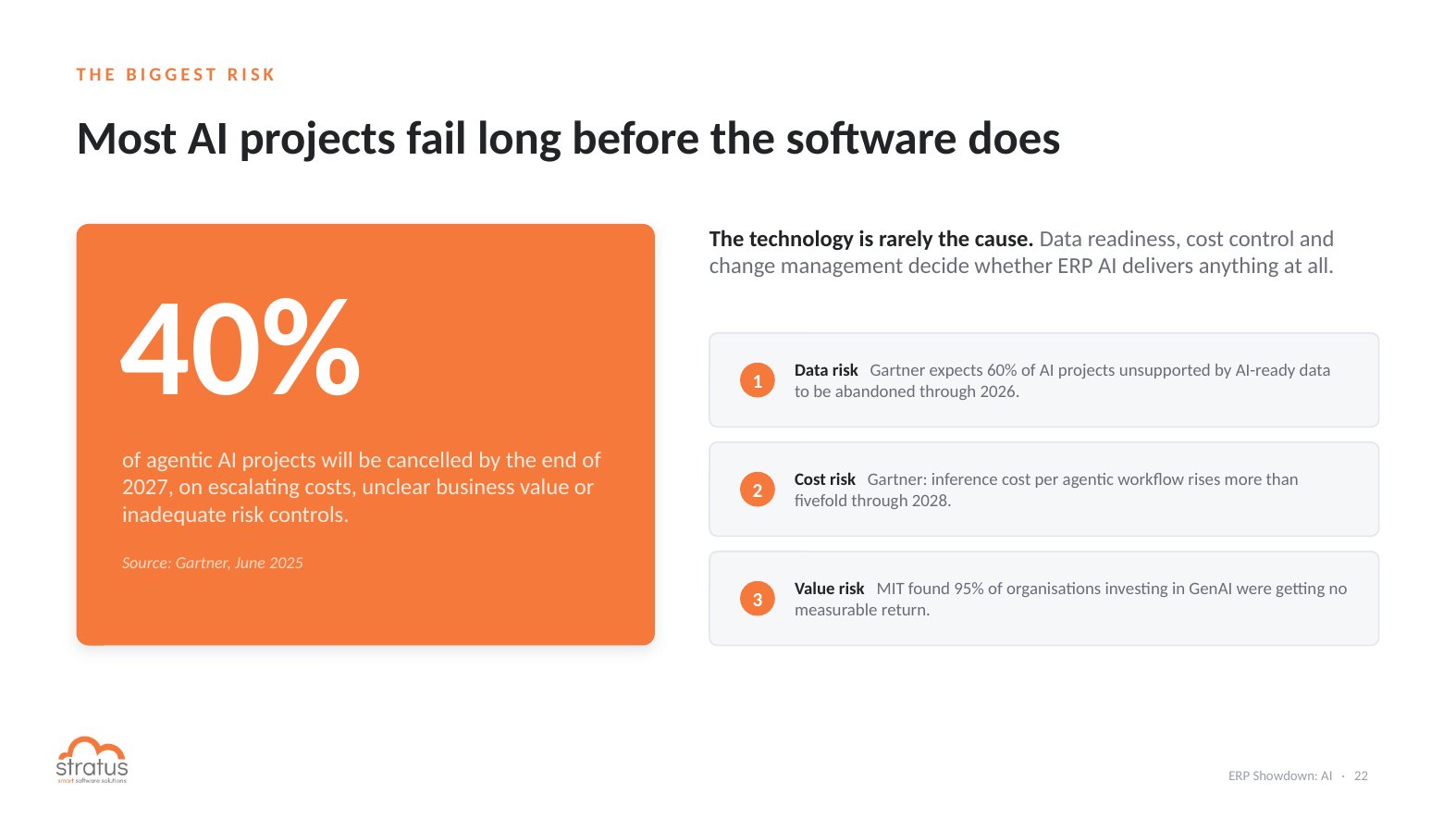
The biggest risk sits outside the software.
The due diligence that protects you
Five questions for the software vendor, and five for whoever implements it.
Ask the software vendor
- Is this generally available in Australia today, or preview?
- What does one transaction cost in credits or AI Units?
- Which model powers it, and can we choose or change it?
- Which country is our data processed in?
- Is our data ever used to train your models?
Ask the implementation partner
- Have you delivered this AI feature for an Australian customer?
- Do you have a critical mass of certified consultants, at least 8 to 10?
- Do you offer local delivery and support, onsite when your operations need it?
- Is there a documented hypercare period after go-live?
- Do you hold Diamond, Platinum or 5 Star partner status with the vendor?
One last tip: ask for every AI claim in writing. Vendor marketing pages and product release notes routinely say different things.
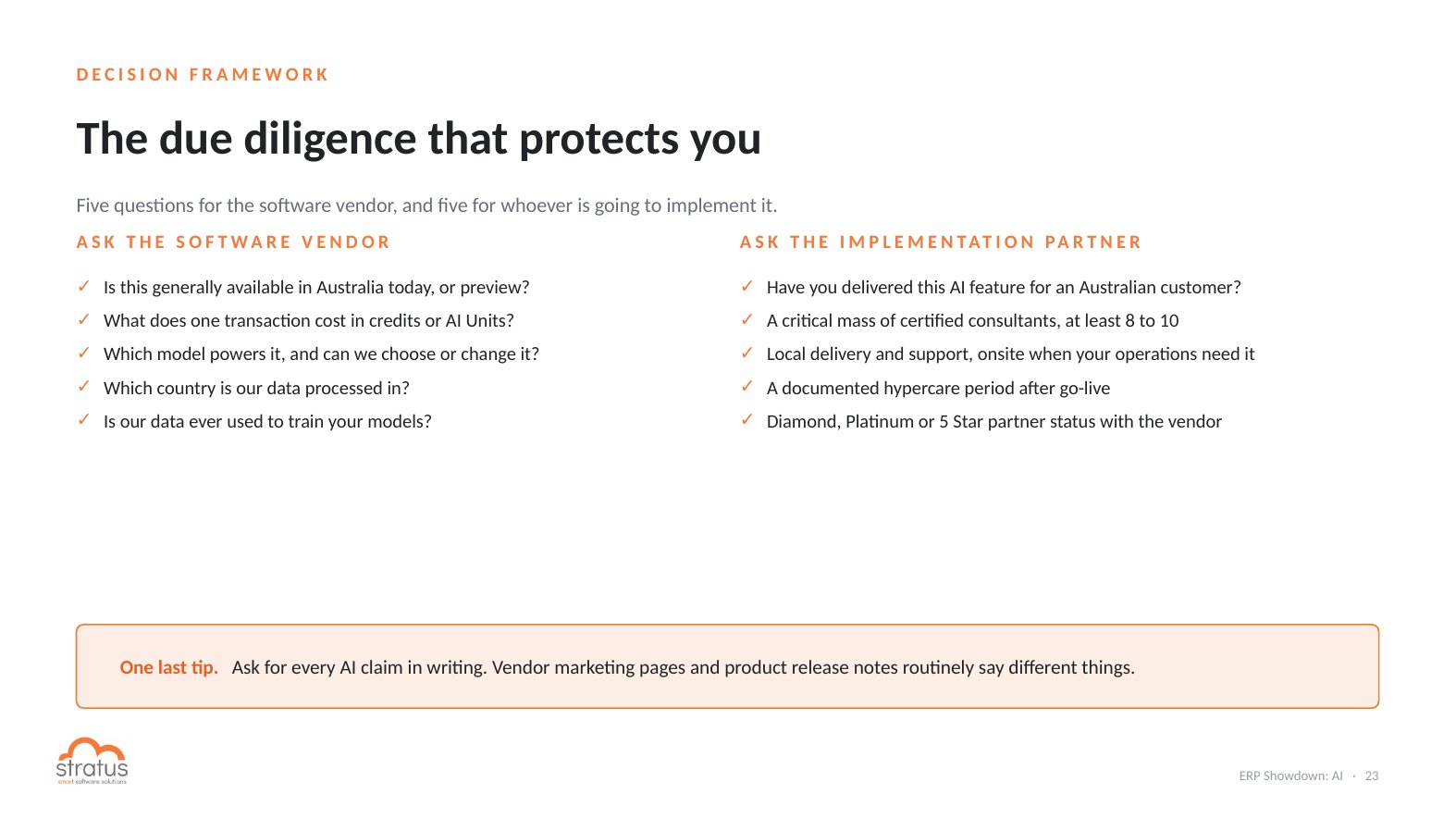
The due diligence checklist from the session.
Why MCP matters when you compare ERPs
MCP (Model Context Protocol) servers came up for almost every platform, and for good reason. An MCP server is the part of your ERP that lets an external AI tool, such as Claude or ChatGPT, connect to it securely and work with its data. It means you are not limited to the AI the vendor ships.
Business Central's MCP server is generally available. Sage's AI Gateway is a read-only MCP server live in Australia. NetSuite has an open MCP connector. Epicor supports MCP through Agent Foundry. Odoo documents an official MCP server for version 20. Pronto's is still coming. For MYOB Acumatica, Stratus has built its own MCP server, which lets businesses build reports in Claude or run deeper analysis over their Acumatica data. If you're also connecting a CRM to MYOB Acumatica, read HubSpot and MYOB Acumatica integration: your options. When you compare platforms, ask what AI is built in and also what other tools can reach your data.
Questions from the live session
If AI features launch late in Australia, will my subscription cost more when they arrive?
It varies by vendor, but as a general rule, yes. Whether it comes as a credit system, a small inclusion with charges above it, or a fee to activate, the AI costs the vendor money to run, and that cost reaches your subscription.
Why do I need an ERP? Can't I overlay AI across all my data sources?
You can connect a tool like Claude to multiple data sources and report across them, and MCP is what makes that possible for your ERP. But the ERP is still the system that runs your transactions, controls and compliance. Overlaying AI works best when a well-structured ERP sits underneath it.
Where is the biggest benefit from AI right now?
For both presenters, it is reporting. Stephen uses Claude to query the ERP and his inbox together to prepare for internal and client meetings and track KPIs. Mark said Stratus's own ERP connection is surfacing things he didn't know to ask. Automation is powerful, but most businesses are still cautious about letting it act. That will change, and over time automation will likely become the bigger time saver.
What training and onboarding do vendors provide for AI agents?
Documentation exists, but if you are new to AI you may not know where to start, where the biggest impact is, or which governance settings keep your data safe. Work with your implementation partner on it. Stratus does this extensively for its clients.
Watch the full ERP Showdown: AI recording to see the whole session, including the live Q&A.
Frequently asked questions
Which ERP has the best AI in Australia in 2026?
It depends on what you need the AI to do. Microsoft Dynamics 365 Business Central and Wiise have the most complete agent toolkit available in Australia. MYOB Acumatica has the safest answer on Australian data. Oracle NetSuite includes the most AI in the licence. Epicor Kinetic has the deepest manufacturing agents. Sage Intacct has the most mature finance AI. Pronto Xi has the strongest data sovereignty.
Which ERP keeps AI processing in Australia?
MYOB Acumatica runs its AI on Anthropic models through AWS Bedrock in ANZ data centres, and Pronto Xi runs AI on GPUs inside Australian-hosted Pronto Cloud. Business Central and Wiise process Copilot in-geo but agents in the US. Oracle's generative AI regions exclude Sydney and Melbourne. Odoo's LLM calls leave Australia. Sage has not disclosed its processing region.
What is the difference between an AI agent and an AI assistant in ERP?
An agent takes actions in the ERP, such as creating a sales order from an email or processing a supplier invoice. An assistant or natural-language query tool answers questions and returns text. If nothing happens in the system, it is not an agent.
How is AI priced in ERP systems?
Usually as a mix. Standard features such as anomaly detection are typically in the licence. Agents and natural-language queries are increasingly metered in credits or AI Units, such as Microsoft's Copilot Credits (US$200 per 25,000) or NetSuite's AI Units (1,000 per user per month included). Some vendors, including Epicor, Sage and Pronto, don't publish AI pricing.
Does MYOB Acumatica have AI?
Yes. MYOB Acumatica includes AP invoice recognition, expense receipt capture and anomaly detection, with AI Studio (now AI Automation) and the AI Assistant rolling out to ANZ in 26 R1. It uses Anthropic models via AWS Bedrock hosted in ANZ data centres.
Is Business Central Copilot included in the licence?
Copilot chat, summaries, analysis and bank reconciliation are included. The Sales Order, Payables and Expense Agents are metered in Copilot Credits, at 50 credits per invoice plus 5 per line.
Is NetSuite's AI available in Australia?
Much of it is. Text Enhance, Narrative Insights, AI bank matching and Intelligent Close are live in Australia. NetSuite Next and Ask Oracle are US and Canada only.
What is an MCP server in an ERP?
An MCP (Model Context Protocol) server lets external AI tools such as Claude or ChatGPT connect to your ERP and work with its data, within the user's security permissions. It lets you use AI beyond what the ERP vendor ships.
Choosing a CRM to sit alongside your ERP? Our follow-on session, CRM Showdown 2026, compares HubSpot, Salesforce, Dynamics 365, Zoho One and four starter tools on AUD pricing, ERP connection and AI in Australia.
About the session
ERP Showdown: Which ERP leads the race in AI? ran on 17 September 2026, presented by Mark Belkin and Stephen Archer of Stratus. It was the second ERP Showdown, following the original eight-platform comparison. Stratus is an independent Australian ERP consultancy with 20+ years and 1,000+ implementations, offices in Perth, Melbourne, Brisbane and Sydney, and is part of Pine Services Group, a global group of ERP specialist consulting firms.
This article is general in nature and is not advice. AI capability claims were researched from vendor documentation, release notes and public announcements as at September 2026. Confirm availability, pricing and regional rollout in writing with each vendor before making a decision.
Free guide
Shortlisting an ERP with AI in mind?
The ERP Selection Guide compares the eight platforms Australian mid-market businesses shortlist, with indicative pricing, industry fit and a ten-step selection process. Want to see what the AI actually does in a real system? Book a no-obligation chat.

ERP Integration: The Key to a Connected Business Ecosystem

Cloud ERP for Civil Construction Accounting | Acumatica





No Comments Yet
Let us know what you think