


Last updated 1 October 2026
HubSpot and Salesforce are the two CRMs Australian mid-market businesses shortlist most often. They solve the same problem in very different ways. HubSpot is built to be run by the business, with marketing, sales and service on one record. Salesforce is built to be customised into almost anything, with the admin and budget that takes. This guide compares them on Australian dollar pricing, setup cost, ease of use, marketing, service, AI, data residency and ERP integration, so you can see which one fits a business of your size.
The short answer
- Choose HubSpot if you're a growing business of roughly 20 to 500 staff that wants marketing, sales and service on one customer record, live in weeks, and run by your own team rather than a dedicated admin.
- Choose Salesforce if you're heading for enterprise complexity (advanced quoting, deep custom objects, complex approvals), you need AI processed in Australia, or you'll fund a dedicated admin or partner to run it.
- On cost: HubSpot Pro is about A$40,116 a year for 10 sales users and 10,000 contacts, against about A$57,960 for Salesforce Core with Marketing Cloud Next. At 50 users it's about A$137,556 against A$202,677.
- On setup: HubSpot typically goes live in 5 to 7 weeks for A$6,000 to A$15,000 (CRM and marketing). A standard single-cloud Salesforce build runs A$35,000 to A$75,000 over 8 to 14 weeks.
All prices are list prices in Australian dollars, excluding GST, read from each vendor's Australian pricing page on 27 September 2026. Where a vendor only shows US dollars, we converted at the Reserve Bank rate for 25 September 2026 (US$1 = A$1.4247). Prices change, so confirm with the vendor before you decide.
Where we stand: Stratus is a HubSpot Platinum partner, and we also implement Microsoft Dynamics. We'll tell you where Salesforce is the better choice, and there are real cases where it is.
HubSpot vs Salesforce at a glance


| HubSpot | Salesforce | |
|---|---|---|
| Mid-market licence | Sales or Service Pro A$140 per seat a month | Core A$273 per user a month |
| Marketing | Marketing Hub Pro A$1,241 a month (3 seats, 2,000 contacts), same record | Marketing Cloud Next from A$2,100 per org a month, a separate product |
| Service | Help desk, knowledge base and chat in Service Hub Pro | Service Cloud. Knowledge, bots and enhanced messaging US$75 per user a month each on Core |
| Typical AU setup | A$6k to A$15k (CRM and marketing), 5 to 7 weeks | A$35k to A$75k (one cloud), 8 to 14 weeks |
| G2 ease of admin | 8.6 (Sales Hub) | 7.9 (Sales Cloud) |
| Gartner 2026 | Challenger, CRM Sales Platforms. Leader, B2B Marketing Automation (6th year) | Leader, CRM Sales Platforms (20th year) |
| Data in Australia | Yes, Sydney data centre since February 2024 | Yes, Hyperforce Australia, with IRAP PROTECTED assessments |
| Where AI is processed | United States | Australia, with an option to block fallback to other regions |
| MYOB Acumatica connector | HubSpot-built sync (CRM records only) plus Acumatica's own connector | MYOB-built MYOB Salesforce Connector |
Pricing in Australian dollars
HubSpot editions
HubSpot sells separate hubs (Marketing, Sales, Service, Content, Data and Revenue) on one platform, priced per seat or per account. Its Australian pricing page shows AUD directly, and prices exclude tax.
- Starter: A$31 per seat a month list, currently discounted to A$11 billed annually for new customers.
- Sales Hub or Service Hub Professional: A$140 per seat a month billed annually (A$155 paid monthly on an annual commitment). 3,000 AI credits a month.
- Sales Hub or Service Hub Enterprise: A$240 per seat a month. 5,000 credits.
- Marketing Hub Professional: A$1,241 a month billed annually, including 3 core seats and 2,000 marketing contacts. Extra contacts are A$351 per 5,000 a month in the first band.
- Marketing Hub Enterprise: A$5,580 a month, including 5 core seats and 10,000 contacts.
- Onboarding: Professional and Enterprise carry a required one-off onboarding fee. HubSpot doesn't show it in AUD. In US dollars it's US$3,000 for Marketing Pro and US$1,500 each for Sales and Service Pro, so roughly A$6,400 for a typical Sales plus Marketing Pro start.
For the full breakdown, including contact tiers and every hub, read our guide to HubSpot pricing in Australia.
Salesforce editions
Salesforce changed its editions on 3 September 2026. Core, Advanced and Max replaced Enterprise, Unlimited and Agentforce 1, and each now bundles Agentforce credits, Slack, Tableau Next and Premier support.
- Starter Suite: A$35 per user a month. No custom objects.
- Pro Suite: A$140 per user a month, annual contract. Capped at 5 flows, 50 custom objects and 3 custom profiles, and Marketing Cloud Next can't be attached to it.
- Core: A$273 per user a month. Includes 500,000 Flex Credits per org per year for Agentforce.
- Advanced: A$553 per user a month. 1 million Flex Credits per org per year.
- Max: A$770 per user a month. 2.75 million Flex Credits per org per year.
- Marketing Cloud Next Growth: A$2,100 per org a month, with 180,000 email credits a year. Advanced: A$4,550 per org a month.
Independent analysts estimate Core is about 11% above the Enterprise edition it replaced. Existing customers keep legacy pricing until renewal.
What each costs at your size
We priced two typical Australian mid-market setups, licence only, using published list prices.
| Scenario | HubSpot Pro | Salesforce Core + Marketing Cloud Next Growth |
|---|---|---|
| 10 sales users, 10,000 contacts | A$40,116 a year, plus about A$6,411 one-off onboarding | A$57,960 a year |
| 50 users (30 sales, 20 service), 50,000 contacts | A$137,556 a year, plus about A$8,548 onboarding | A$202,677 a year. About A$228,322 with the knowledge base for 20 service users |
| 50 users on the top tier | Enterprise A$218,400 a year | Advanced + Marketing Cloud Next Advanced about A$400,077 a year |
A few notes on those numbers. The Salesforce 50-user figure includes an estimate for extra Data 360 profiles, because Salesforce doesn't publish how many contacts Marketing Cloud Next includes. HubSpot's onboarding fees are converted from US dollars. Salesforce Pro Suite looks cheap at A$16,800 a year for 10 users, but it can't take Marketing Cloud Next, so it isn't a like-for-like option if you need marketing automation.
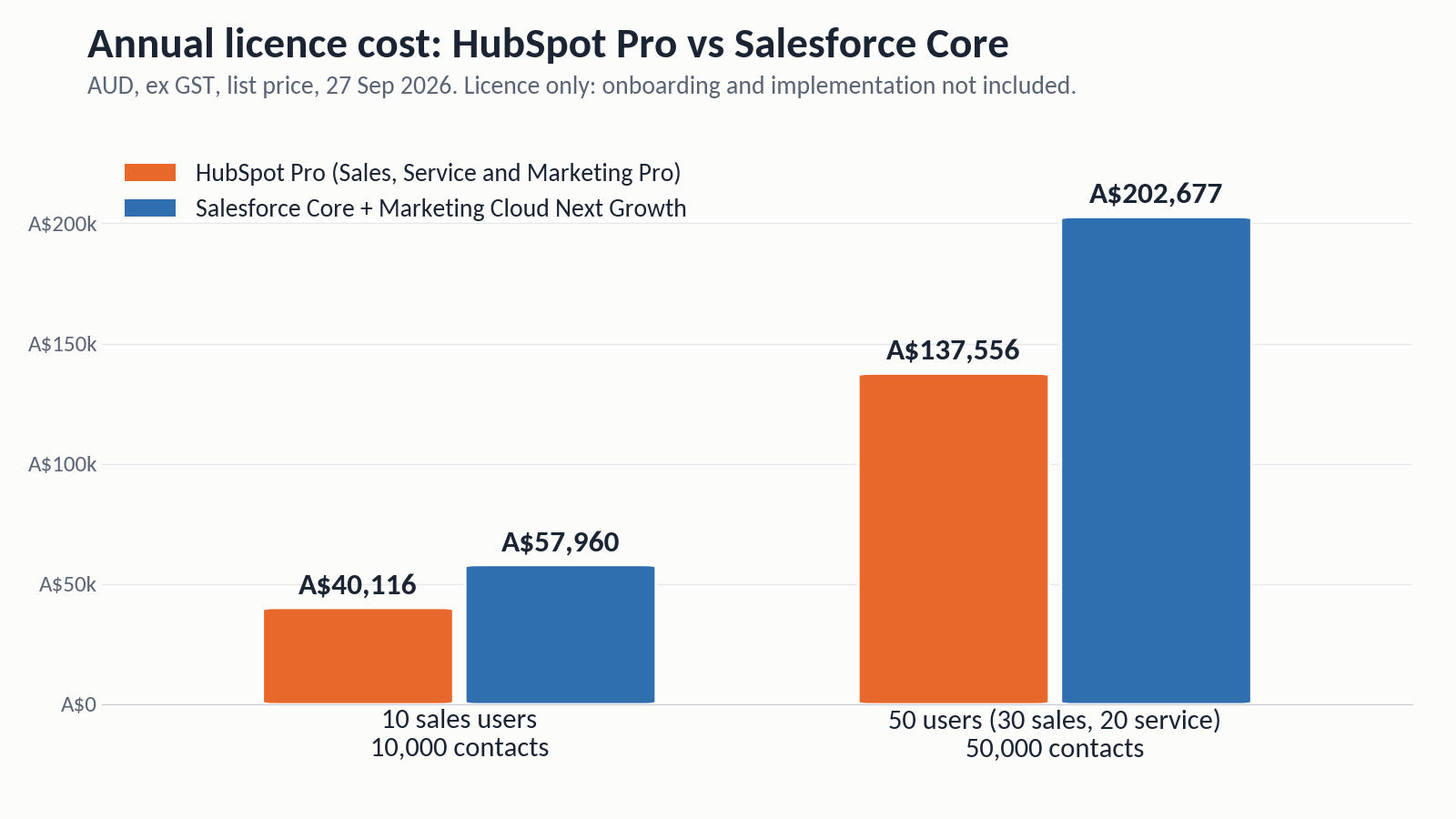
HubSpot Pro vs Salesforce Core with Marketing Cloud Next, annual licence in AUD.
Setup, go-live and who runs it
The licence is only part of the cost. The bigger gap between these two is often what it takes to get live and keep running.
- HubSpot: Australian partners typically quote A$3,000 to A$8,000 for CRM setup, A$6,000 to A$15,000 for CRM and marketing, and A$15,000 to A$40,000 if a website rebuild is included. A mid-market new build usually takes 5 to 7 weeks. In our experience, a marketing or sales operations lead runs it alongside their day job.
- Salesforce: QuickStart packages run A$15,000 to A$25,000 over 4 to 6 weeks. A standard single-cloud build is A$35,000 to A$75,000 over 8 to 14 weeks. Two clouds run A$65,000 to A$120,000, and multi-cloud projects A$120,000 to A$250,000 or more. Most businesses need a dedicated admin or a managed service, which in Australia runs about A$2,000 to A$8,000 a month.
On G2, HubSpot Sales Hub scores 8.6 for ease of admin and 8.3 for ease of setup, against 7.9 and 7.8 for Salesforce Sales Cloud. To be fair to Salesforce, it wins on "meets requirements", 8.8 against 8.6. That's the trade-off in one line: Salesforce can do more, and HubSpot is easier to run.
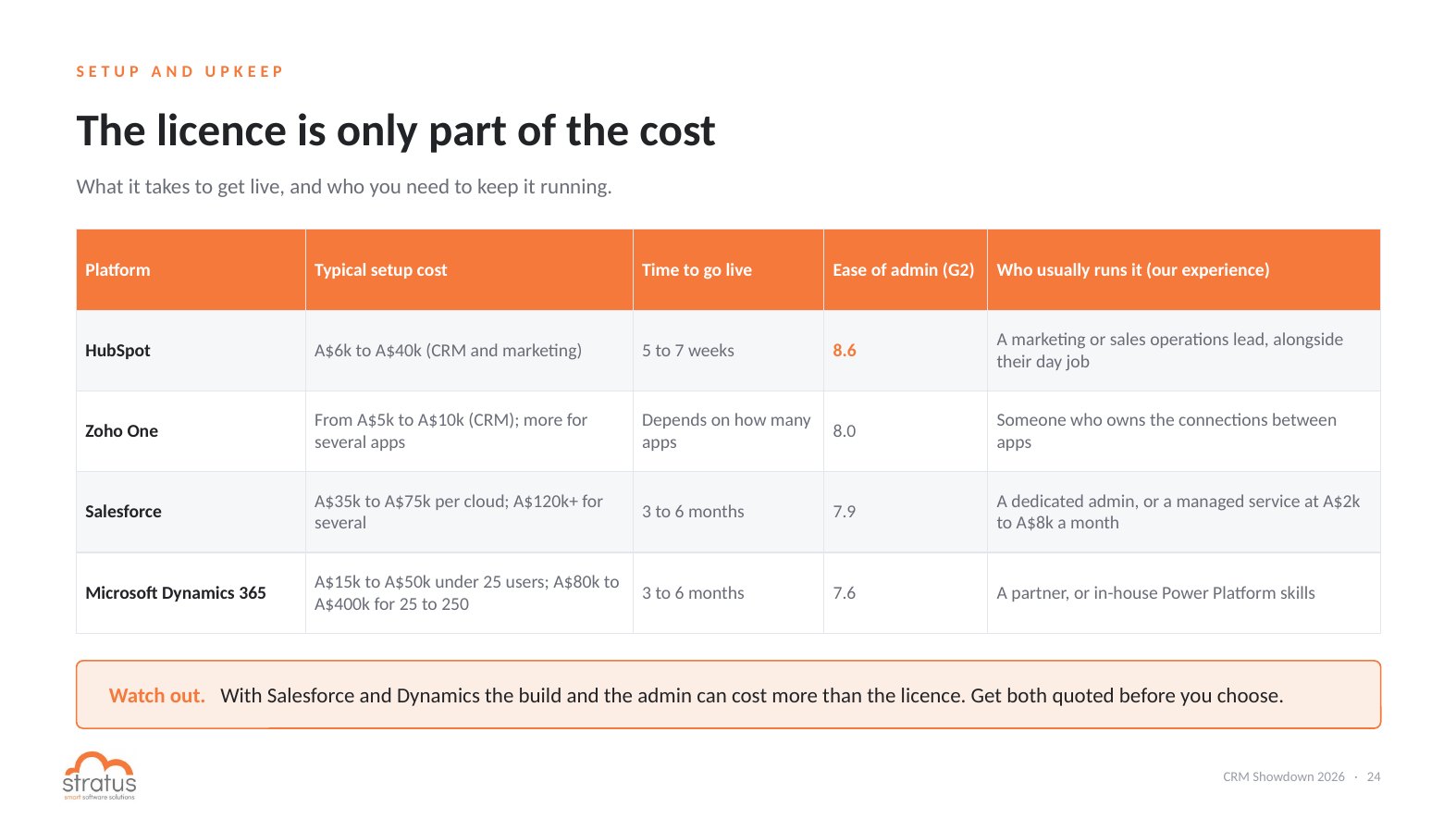
Setup cost, time to go live and who runs it, from CRM Showdown 2026.
Customisation and limits
This is where Salesforce earns its reputation. It's the most customisable CRM on the market, with the deepest options for configure-price-quote, complex approvals and bespoke data models.
- HubSpot: custom objects and a sandbox are Enterprise only, capped at 10 object definitions and 1 million custom object records. Professional includes 300 workflows, 100 custom reports and 1,000 custom properties per object. Enterprise lifts that to 1,000 workflows and 500 reports.
- Salesforce: Pro Suite is tight, with 5 flows, 50 custom objects and 3 custom profiles. From Core up, limits are far higher (Enterprise-class orgs allow around 200 custom objects and 2,000 active flows), and the platform can be extended with code.
Signs you'd outgrow HubSpot: you need more than 10 custom objects or a million custom records, you're hitting the 1,000-workflow cap, or your process relies on complex CPQ or multi-entity ERP-led workflows. If that's you today, Salesforce deserves a serious look.
Marketing automation
HubSpot started as a marketing platform and it shows. Gartner named it a Leader in B2B Marketing Automation Platforms for the sixth year running in September 2026. Marketing sits on the same record as sales and service, so a campaign can be traced to a deal and then to the service history of that customer, without a separate data layer.
Salesforce's marketing is a separate product. Marketing Cloud Next starts at A$2,100 per org a month and needs Enterprise-class editions (Core and up in practice). The Growth edition's 180,000 email credits a year work out to only 3.6 emails per contact per year at 50,000 contacts. Salesforce also sells Account Engagement (formerly Pardot) from A$1,750 per org a month for 10,000 contacts.
Customer service
HubSpot Service Hub Professional includes ticketing, 50 help desk spaces, a knowledge base with up to 2,000 articles, surveys and live chat, all on the same customer record your sales team uses.
Salesforce Service Cloud is one of the strongest service platforms available, and Gartner rates it a Leader in CRM customer engagement. On Core, though, the knowledge base, Einstein Bots and enhanced messaging are each an extra US$75 per user a month. For 20 service users, the knowledge base alone adds about A$25,600 a year.
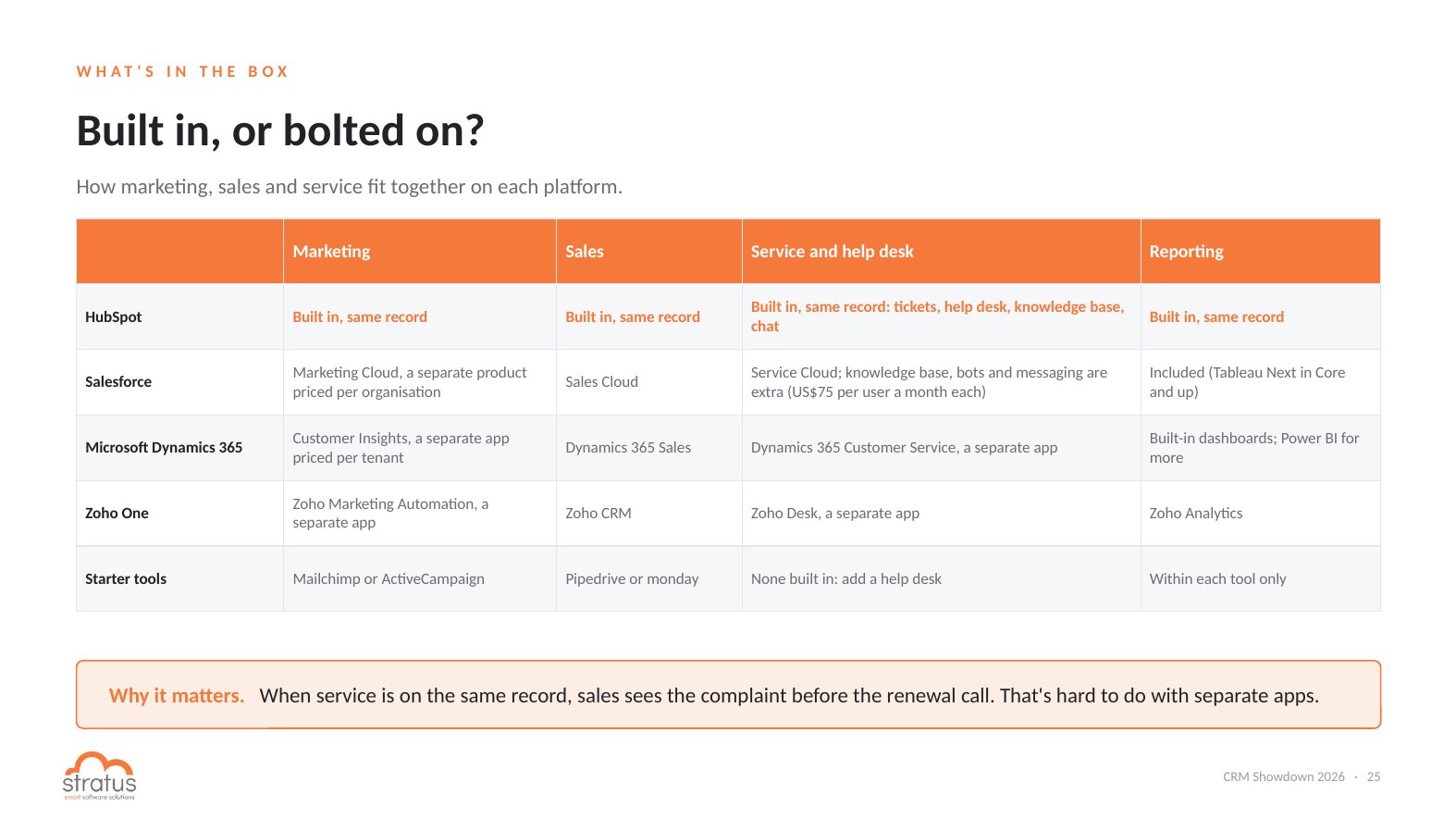
How the platforms package marketing, sales and service.
AI: what's live and where it runs
HubSpot
- Breeze Assistant, which summarises records and drafts content, is generally available and included with core seats.
- The Customer Agent is generally available and charged per outcome: 50 credits (about A$0.71) per resolved conversation. A Professional account's 3,000 monthly credits cover roughly 60 resolutions.
- The Prospecting Agent is 100 credits (about A$1.42) per lead recommended for outreach.
- The Campaign, Content and Nurture Agents announced in September 2026 are still in public beta.
- Extra credits cost about A$14 per 1,000, don't roll over, and by default an overage upgrades you to a higher credit tier for the rest of your contract unless you turn on pay-as-you-go.
- AI processing runs in the United States, even when your CRM data is hosted in Sydney.
Salesforce
- Agentforce is included from Core up, drawing on the org's yearly Flex Credit allowance. Core's 500,000 credits cover about 25,000 standard agent actions a year across the whole org. Top-ups are A$700 per 100,000.
- For Australian orgs, AI requests are routed to Australian endpoints, and an "In-Region Model Requests Only" setting can switch off fallback to other regions.
- Agentforce on Hyperforce Australia holds an IRAP PROTECTED assessment, which matters for government and defence suppliers.
- Some of the newest AI, including the Koa reasoning model, launched in the US only.
If AI data sovereignty is a hard requirement, Salesforce is ahead today. If it isn't, HubSpot's outcome-based agent pricing is easier to predict for a mid-market team.
Data residency and compliance
Both can host your CRM data in Australia. HubSpot has run a Sydney data centre since February 2024 and holds SOC 2 Type II and related attestations, but it doesn't list an IRAP assessment, and analytics, AI and some marketplace apps can move data to the US. Salesforce hosts on Hyperforce Australia and has IRAP PROTECTED reports covering its core CRM, Data 360, Marketing Cloud and Agentforce. For businesses with government clients, that's a genuine point in Salesforce's favour.
ERP integration
A CRM that can't see orders, invoices and credit status leaves your sales team guessing. Here's how each connects to the ERPs we see most in Australia.
- MYOB Acumatica: Salesforce has the only connector built by MYOB itself, syncing accounts, contacts, opportunities and cases, with inventory flowing to Salesforce. HubSpot has a HubSpot-built sync that covers CRM records only, and Acumatica publishes its own HubSpot connector. Most HubSpot and Acumatica projects need the integration designed properly. Read HubSpot and MYOB Acumatica integration: your options.
- NetSuite: HubSpot's own NetSuite integration is one of its strongest, syncing deals, orders, invoices and products. Oracle's NetSuite connector for Salesforce is listed for North America.
- Business Central and Wiise: neither HubSpot nor Salesforce is the natural fit here. Dynamics 365 Sales has the native, same-vendor link. See the CRM Showdown 2026 comparison for how it stacks up.
- Xero: Salesforce has a strong third-party option (Breadwinner). HubSpot's Xero app is built by Xero and covers contacts and invoices.
Which should you choose?
Choose HubSpot if
- You're roughly 20 to 500 staff and growing
- You want marketing, sales and service on one record, in one product
- You want to be live in weeks and run it without a full-time admin
- Marketing automation matters as much as the sales pipeline
- You want predictable licence and implementation costs
Choose Salesforce if
- You need deep customisation: complex CPQ, many custom objects, bespoke approvals
- You're scaling towards enterprise and will fund an admin or partner on retainer
- AI must be processed in Australia, or you need IRAP-assessed services
- You run MYOB Acumatica and want an MYOB-built connector out of the box
Moving between them is common. A mid-market migration from Salesforce to HubSpot typically takes 9 to 11 weeks, and Australian partners quote A$8,000 to A$25,000 for the migration work.
Weighing HubSpot and Salesforce? Watch the full CRM Showdown 2026 comparison of eight CRMs, with AUD pricing for each. Get the recording
Frequently asked questions
Is HubSpot cheaper than Salesforce in Australia?
Yes, at typical mid-market sizes. For 10 sales users and 10,000 contacts, HubSpot Pro is about A$40,116 a year against about A$57,960 for Salesforce Core with Marketing Cloud Next Growth. For 50 users and 50,000 contacts, it's about A$137,556 against A$202,677 (list prices, ex GST, September 2026). HubSpot implementations also cost less, typically A$6,000 to A$15,000 against A$35,000 to A$75,000 for one Salesforce cloud.
Is HubSpot easier to use than Salesforce?
On G2, HubSpot Sales Hub scores 8.6 for ease of admin and 8.3 for ease of setup, against 7.9 and 7.8 for Salesforce Sales Cloud. Salesforce scores higher on meeting requirements (8.8 against 8.6), reflecting its depth of customisation.
Can HubSpot handle enterprise businesses?
HubSpot Enterprise supports custom objects, sandboxes, 1,000 workflows and hierarchy forecasting, and Gartner rates it a Challenger for CRM sales platforms. It hits limits at more than 10 custom object definitions or 1 million custom object records, where Salesforce's flexibility is stronger.
Does HubSpot store data in Australia?
Yes. HubSpot has hosted customer data in its Sydney data centre since February 2024. Its AI features are processed in the United States, even for Sydney-hosted accounts.
Does Salesforce process AI in Australia?
For Australian orgs, Salesforce routes generative AI requests to Australian endpoints and offers an "In-Region Model Requests Only" setting that blocks fallback to other regions. Agentforce on Hyperforce Australia holds an IRAP PROTECTED assessment.
Which CRM works best with MYOB Acumatica?
Salesforce has the only connector built by MYOB. HubSpot works with MYOB Acumatica through a HubSpot-built sync of CRM records, Acumatica's own connector, third-party syncs or a custom integration, and the integration usually needs designing properly.
How long does it take to move from Salesforce to HubSpot?
A typical mid-market migration from Salesforce to HubSpot takes 9 to 11 weeks, depending on how much customisation and data you have.
About this comparison
This guide draws on the research behind Stratus's CRM Showdown 2026 webinar, presented by Mark Belkin and Stephen Archer on 29 September 2026. Stratus is an Australian consultancy with 20+ years and 1,000+ implementations, a HubSpot Platinum partner and an MYOB Acumatica Diamond partner.
This article is general in nature and is not advice. Prices are vendor list prices in AUD excluding GST, checked 27 September 2026, and can change at any time. Confirm pricing and features with each vendor before you decide.
HubSpot Platinum partner
Not sure which fits?
We implement HubSpot and Microsoft Dynamics, and we'll tell you straight if Salesforce is the better choice for you. Bring your seat count and contacts and we'll price both.
CRM Showdown 2026: The Top 8 CRMs Compared for Australian Business

HubSpot Pricing in Australia (2026): What It Really Costs in AUD



No Comments Yet
Let us know what you think